1. The Ultimate Guide For Your Software Project Rescue
When decisions around a software product start feeling unclear, progress usually slows, a signal that your software project may need a structured software project rescue. Teams hesitate to make changes. Releases require extra caution, and even simple questions take too long to answer.
According to the industrial reports, the projects in this state are exposed to higher costs and schedules unless corrected. It is not a bug at this stage or a deadline that was overlooked. It is a fact that there is no clarity and predictability in the system itself.
A software project rescue begins at this point, not by moving faster, but by restoring the ability to make decisions without fear. This guide is written for founders, product leaders, and decision-makers who are dealing with more than minor delivery issues.
It is for cases where normal development has broken down, where confidence in the system is low, and where repeated fixes have failed to produce lasting improvement. In these cases, an IT software project rescue is less about speed and more about restoring safety and clarity.
Many teams reach this point after trying to solve the problem externally:
- New developers are added
- Features are paused or rewritten
- Parts of the system are changed without fully understanding the risks
Even experienced teams struggle here when there is no structured approach to software development project rescue that prioritizes stability before progress.
This page is not a quick checklist or a promotional overview of software project rescue services. It is a practical reference to help you think clearly under pressure. The sections that follow explain what “failure” actually means in real software systems, why many rescue attempts make things worse, and how controlled recovery differs from constant patching.
You do not need to read this guide in one sitting, so you can focus on what you want most right now. If you are evaluating IT software project rescue solutions, the goal here is to help you do that without urgency, fear, or guesswork.
The intent is simple: to help you move from confusion to control, one clear decision at a time.
2. What “Failed” Really Means (And Why Most Projects Aren’t Hopeless)
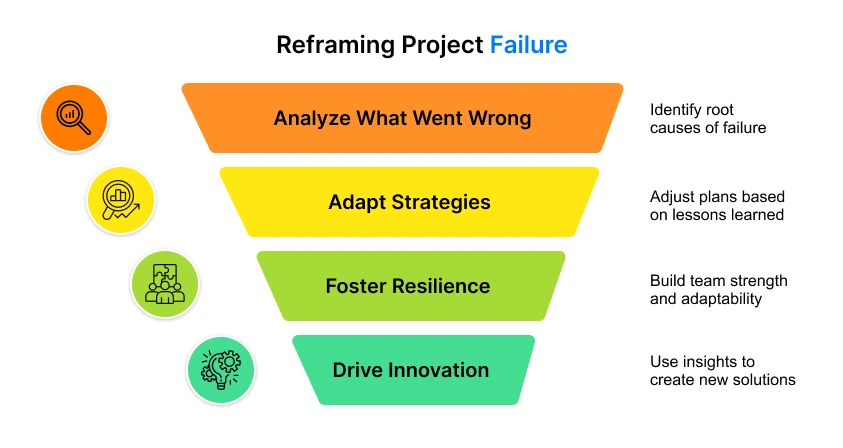
In software, the word failed is often misleading. Many projects are labeled failures long before they are truly beyond recovery. Early signs of failure are inadequately happens suddenly. They occur when the decisions no longer result in predictable outcomes.
It is essential to identify these symptoms when embarking on a rescue mission for an IT software project. The research carried out by the Standish Group CHAOS Report has found that projects fail slowly, not suddenly. A project is rarely “failed” because of one minor mistake. More often, it reaches this point after a series of small compromises.
Early signs often include:
- Shortcuts that accumulate
- Temporary fixes become permanent.
- Decisions are made with incomplete information
Eventually, progress becomes unpredictable, and trust in the system begins to be lost.
This is the moment when teams begin to talk about rescue. A software project rescue is typically considered not because development has stopped, but because continuing feels increasingly risky. Changes carry unknown risk. Timelines lose meaning. The system no longer responds in expected ways.
From an IT software project rescue perspective, failure is better understood as a loss of control. The product still exists. Users may still rely on it. Revenue may even be coming in. But internally, the team can no longer answer basic questions with confidence.
That uncertainty is what turns routine work into constant firefighting. It is important to separate this state from true irrecoverability. Few systems are irreparable. The result depends less on the appearance of the code and more on whether the system can still be understood, stabilized, and controlled. This distinction is central to any responsible software development project rescue.
In practice, projects that are described as “failed” usually share a few underlying characteristics:
- Progress depends on a small number of individuals
- Changes introduce side effects that are hard to explain
- Releases feel stressful rather than routine
- Technical decisions are postponed because the risk is unclear
None of these signals means a project is finished. They indicate that the system has drifted beyond its original boundaries without the controls needed to manage that growth.
A proper software project rescue addresses this drift before attempting improvement.
This is also where many software project rescue services make mistakes. They treat visible symptoms as proof that the entire product needs to be replaced. In reality, some systems need rebuilding, but many only need the structure restored and the risk reduced. The difference cannot be determined without careful analysis.
Understanding what “failed” really means allows you to pause before making irreversible decisions. It creates space to evaluate IT software project rescue solutions based on evidence rather than frustration. Most importantly, it reframes the situation from one of collapse to one of correction.
Failure, in this context, is not an endpoint. It is a signal that the way the system is being managed no longer matches its complexity. Recognizing that early is often what makes recovery possible.
3. How do you know it’s Time for a Rescue? Not Just Another Fix
A project usually requires rescue long before it is labeled as failed. The shift is subtle. Work continues, tasks get completed, and releases still happen. What changes first is the team’s ability to anticipate outcomes with certainty. When a software project reaches this stage, the signals are often consistent across industries and team sizes.
Common signals include:
- Changes require unusually long discussions because their impact is unclear
- Critical decisions depend on only a few individuals rather than shared understanding or documentation
- Releases are delayed not by work, but by uncertainty about what might break
- Fixes repeatedly create issues in previously stable areas
- Timelines are frequently revised because estimates rely on assumptions rather than system knowledge
Studies show that early identification of these signals reduces project recovery costs by up to 40% (McKinsey Technology Transformation). None of these signals indicates poor intent or lack of effort. They indicate that the system has reached a level of complexity where informal control no longer works.
In these situations, an IT software project rescue becomes relevant not because the product has stopped working, but because the system no longer supports reliable decision-making. It is to recognize the point at which further action is to increase risk, rather than decrease it.
4. The Real Cost of Leaving Software Projects Unresolved: Business, Financial, and Technical Impact
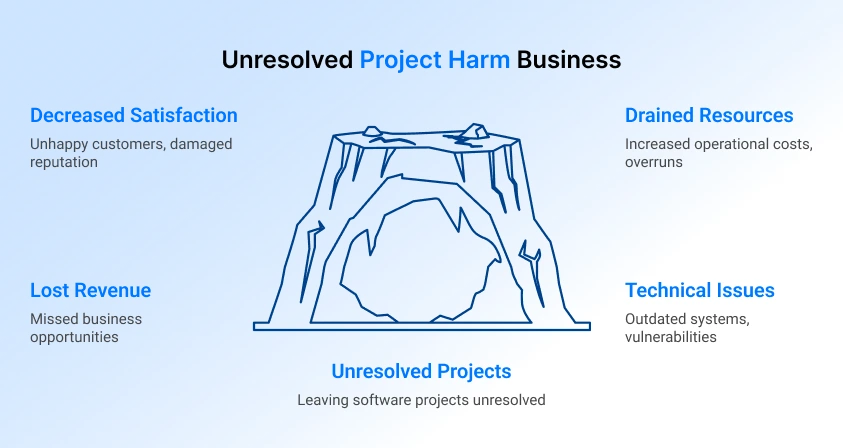
The cost of an application project left unresolved is not simply paid in a single failure. It gradually accumulates in the form of small, repetitive inefficiencies. In the initial phase, the effect is largely operational. Teams stay busy, but progress becomes harder to measure. Decisions take longer. Changes feel heavier than they should. Over time, this turns into measurable business drag.
The most common costs appear in predictable ways:
1. Decision latency increases – Teams wait for context, slowing delivery even when no work is blocked.
2. Delivery effort rises without output growth – More time is spent rechecking and reworking changes.
3. Planning accuracy degrades – Estimates rely on assumptions rather than system knowledge.
4. Operational risk becomes normalized – Manual checks and informal approvals become routine.
5. Knowledge concentrates instead of scaling – System understanding is limited to a few individuals.
As these patterns continue, the cost shifts from operational to strategic.
Leadership time moves away from product direction and toward risk management. Roadmaps become conservative, not because ambition is gone, but because uncertainty dominates decision-making.
Industry statistics always verify the compounding nature of this problem. The industrial report (2024-2025) illustrates that projects lingering in a “challenged but active” status end up costing much more to rectify than those that are addressed sooner, even if the scope of work doesn’t change.
McKinsey & Company’s technology transformation team’s research suggests that procrastination in making structural changes will result in increased costs compared to managed stabilization, mostly because of the rework involved.
The results of reports further illustrate that unclear systems and inefficient use of tools directly impact the actual amount of work being accomplished by engineers, even as the number of engineers grows.
None of these costs comes from poor intent or lack of effort. They emerge when a system grows beyond the controls used to manage it. Leaving a project unresolved is not an efficient decision-making process. It allows complexity, uncertainty, and coordination costs to grow simultaneously.
Addressing the situation early is not about going in high pressure situation. It is about stopping the compounding effect before it becomes the default way the organization operates. That is the net cost of delay, and the reason software project rescue exists as a discipline, not as a last resort.
5. Why Software Projects Break Down as They Scale
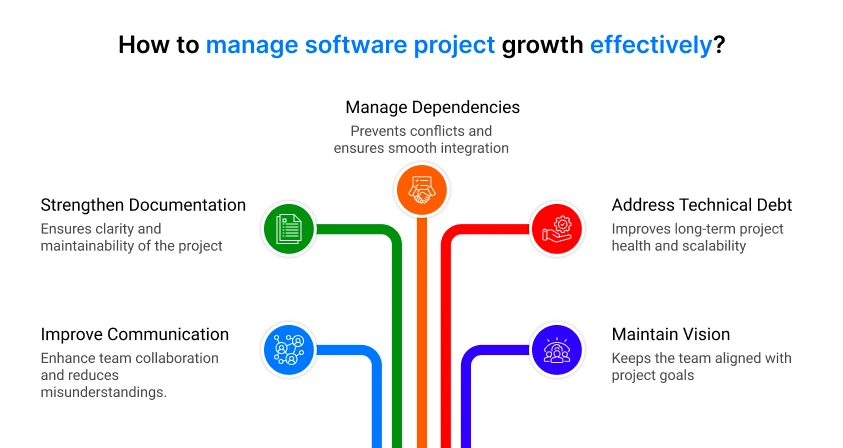
Most software projects don’t fail because of one deviation. They drift into trouble when early decisions quietly stop aligning with the product's reality. At the beginning, systems are designed to move fast. That’s usually the right decision.
The trouble begins when the product itself expands, but the organization remains the same. What once felt simple becomes tightly coupled. Small updates require careful coordination. The system still works, but it resists change.
Several patterns tend to appear together.
5.1. Architecture designed only for the early stage
The product was shaped around quick launches and a limited scope. As usage grows, the system that once moved fast now slows future work and increases risk. The system is not broken; it is merely being driven beyond what it is meant to handle.
5.2. Missing senior technical ownership
Decisions are made, but no one owns them in terms of their impact on the overall system. Trade-offs accumulate. Long-term impact is discussed later, which often means never. Over time, consistency is lost.
5.3. Unsafe or informal release practices
Deployments begin to feel unpredictable. Extra checks appear. Rollbacks become common. People hesitate to add-on changes, not because the work isn’t complete, but because the results are uncertain.
5.4. Knowledge tied to Individuals
Some areas are avoided because knowledge is held by only one or two people. Progress depends on availability, not readiness. When those people step away, delivery slows immediately. These issues don’t point to poor execution or weak teams. They signal that the product has crossed a complexity threshold without the supporting structure.
Software projects break down when growth outpaces clarity. Not because the team didn’t succeed, but because the system was never adapted for what it became. These patterns, together, show how growth reveals weaknesses in structure and clarity.
6. Why Quick Fixes Often Make Failing Projects Worse
When a project starts slipping, the signs are familiar. Deadlines move. Bugs increase. Team energy drops. In that moment, instinct takes over: do something, fast. So leaders react.
- Hiring expert developers without addressing structural issues
- Weekend crunches or rushed sprints that add temporary fixes
- Tool or framework replacements that ignore root causes
These actions look decisive. In reality, they often turn a recoverable project into a long-term failure.
6.1. The Core Problem: Treating Symptoms, Not Causes
Most reactive solutions tend to fix the apparent, rather than the broken, bits. In a buggy release, an all-hands debugging sprint is needed. But if the real issue is:
- unclear requirements
- architectural shortcuts made early
- scope that shifted without alignment
Then the bug is just a symptom. Fixing it doesn't cure it but only hides it. This is why we keep getting the same problems, release after release.
6.2. How Technical Debt Quietly Compounds?
Every rushed decision adds invisible weight to the system. Quick patches layer fragile code atop unstable logic. Nothing breaks immediately, which creates a failure of progress. But the risk accumulates.
Systems rarely fail during calm periods. They fail when:
- traffic spikes
- deadlines tighten
- A major launch is on the line
That’s when shortcuts surface, and when recovery becomes expensive.
6.3. The Human Cost Most Leaders Miss
Technical problems are only half the damage. Engineers recognize panic decisions instantly.
- Forced overtime feels like chaos, not commitment
- Last-minute hires feel like desperation, not strategy
Trust erodes quietly. The best people don’t complain. They disengage. Then they leave. Once institutional knowledge walks out the door, even a correct fix struggles to land.
6.4. What Real Project Rescue Actually Looks Like
Rescue is not about speed. It’s about stopping the wrong motion. Effective recovery begins with a deliberate pause, often 48–72 hours after diagnosis, not delivery.
That pause is used to:
- map real fracture points
- Interview the team without blame
- audit decisions, not just code
Only after this clarity emerges can triage begin.
6.5. The Triage Framework That Works
Once root causes are visible, leaders can make clean decisions:
- Preserve what’s stable and valuable
- Scrap what can’t be saved
- Rebuild what must endure
This is slower than patching, but far faster than repeated failure.
6.6. The Question Most Founders Avoid
Patching assumes one thing: The blueprint was sound, and execution failed. Rescue asks the harder question: Was there ever a viable blueprint? Avoiding that question doesn’t save time. It creates complexity. And complexity compounds silently until it becomes irreversible.
6.7. The Real Meaning of Moving Fast
At other times, the only way to move ahead is to move backward. Not to hold back progress, but to guide it. Speed without direction isn’t momentum. It’s drift. And drift sinks more projects than any single mistake ever could.
7. How NetSet Software Solutions Approaches Software Rescue
At NetSet Software Solutions, software rescue typically begins after confidence has already eroded. Founders arrive with something running, something broken, and an unresolved concern that no one has fully explained why the system behaves the way it does.
Our approach begins by restoring system understanding before proposing change. We examine how the product evolved, which assumptions shaped early decisions, how ownership was defined, and where clarity was lost as the system grew.
In almost every case, failure did not arrive suddenly. It accumulated quietly through small, reasonable compromises that were never revisited. At this stage, the most important signals are rarely defects in the code. They are signs of lost predictability:
- Teams hesitate before making changes
- Certain areas of the system are avoided
- Simple updates require excessive validation
- Risk is recognised but cannot be clearly explained
These behaviors indicate where control has weakened. Every software project rescue is grounded in verifiable facts. What is stable and valuable is preserved. What is fragile is identified early.
What cannot be retained without introducing long-term risk is discussed openly, even when that assessment is difficult. Reassurance without evidence is intentionally avoided. Across stalled and incomplete projects, these signals form a consistent pattern:
- Progress continues without clear system-level ownership
- Short-term fixes accumulate without retiring earlier assumptions
- Delivery pressure overrides structural integrity
- Decisions are made without re-evaluating their long-term impact
NetSet approaches recovery deliberately. Stability comes before expansion. Control comes before speed. Before building anything new, we focus on restoring the team’s ability to answer basic questions with confidence: what will change, what depends on it, and what risk is being accepted.
Every action is evaluated against cost, time, operational risk, and long-term maintainability. Trade-offs are made explicit, enabling founders to make informed decisions and decide based on data, not hope.
A few core principles guide this work :
- You cannot fix what you do not fully understand
- Rewriting everything is rarely the first or best answer
- Technical decisions must align with budget, runway, and team capacity
- Straight answers matter more than reassuring ones
For founders addressing a failed software project, this mindset is deliberate. Rescue is not about dramatic turnarounds or heroic sprints. It is about restoring predictability, reducing uncertainty, and creating a system where decisions once again produce reliable outcomes.
That is how confidence returns, quietly, through control rather than promises.
8. THE SOFTWARE RESCUE PHASES
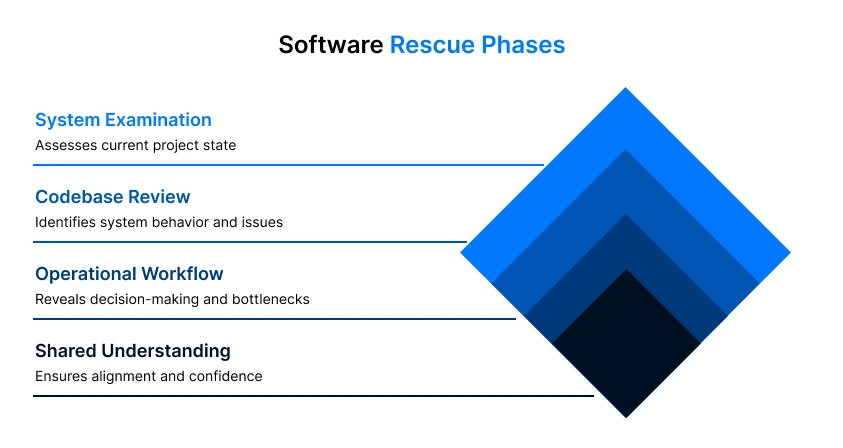
(Method, not marketing)
8.1. Phase 1: Stabilizing and Understanding the Project
When NetSet steps into a stalled or struggling IT project, the priority is to get a clear view of reality. Founders often inherit uncertainty, features behave inconsistently, deadlines slip, and teams disagree on priorities. This phase aims to replace guesswork with clarity.
We start by examining the system as it exists today. Not the original plan, not the roadmap, what’s actually live and in use. This step helps identify which parts of the project are solid and which are fragile. Understanding this early prevents wasted effort and unnecessary risk.
Next, the codebase is reviewed. This isn’t about judging quality; it’s about learning how the system behaves and where potential issues may lie. Some areas can safely support new work; others may require careful handling before any further development.
The operational workflow is equally important. We look at:
- How decisions have been made and communicated
- Where ownership of tasks and features is clear, and where it’s ambiguous
- How work moves from concept to deployment
- Points where delays or bottlenecks repeatedly appear
These observations reveal patterns that often explain why a project stalled. Over the years, we’ve seen these patterns emerge repeatedly: delayed approvals, unclear responsibilities, and silent technical debt.
No immediate fixes are applied during this phase. The goal is to create a shared understanding among founders, stakeholders, and teams. Once everyone sees the same picture, rescue efforts move forward with confidence instead of guesswork.
By the end of Phase 1, the project is stabilized mentally and technically. Founders can see which areas are safe to build on, which need attention, and where to focus energy first. This foundation is critical; it sets the stage for every subsequent rescue action.
8.2. Phase 2: Risk Containment and Stabilization
Once the project’s current state is clear, NetSet focuses on containing risk and creating steady ground. In many software project rescue cases, the pressure to act too quickly can lead to more delays or hidden errors.
This phase is about regaining control and making the project manageable again. We start by observing the areas that are functioning reliably and those that are sensitive to change. Not just the code, but also how teams coordinate, decisions flow, and where bottlenecks have been recurring. These insights help identify points that could cause surprises if handled incorrectly.
Key actions at this stage include:
- Mapping connections between modules, processes, and teams to spot hidden dependencies
- Assigning clear ownership so every task has a responsible point of contact
- Highlighting sections of the project that require careful attention before any changes
- Setting up straightforward communication routines to prevent missteps and confusion
8.3. Phase 3: Structural Problem Identification
No major fixes have been applied yet. The goal is to stabilize the environment and ensure that any future work happens with confidence, not guesswork. By containing the sensitive areas, NetSet Software Solutions keeps the project from slipping further while preparing for structured recovery.
For founders who are rescuing troubled projects, this phase often brings the first sense of relief. You start to recognize which areas can safely evolve, where caution is needed, and how NetSet manages risk behind the scenes.
The project doesn’t feel chaotic anymore; it feels under control and predictable. By the end of this phase, the project is monitored, structured, and steady, ready for the next steps in recovery.
NetSet takes ownership of this containment, guiding founders and teams so that subsequent actions can be deliberate, informed, and successful. This phase focuses on uncovering the hidden structural issues that quietly slow down software projects.
In software project rescue, success isn’t about patching one bug or hitting a deadline; it’s about finding the root causes that repeatedly stall progress. Identifying these causes early prevents repeated mistakes and gives teams a clear, actionable path forward.
The first step is careful observation. What seems like a minor delay or recurring error often points to deeper gaps: unclear priorities, fragmented communication, or inefficient workflows. Treating these signs as clues rather than problems ensures solutions target the system, not just the surface.
Key steps include:
- Track recurring issues: Maintain a record of what consistently slows progress
- Identify root causes: Look beyond visible problems to uncover systemic gaps
- Focus on signals, not noise: Avoid chasing one-off errors that don’t indicate deeper issues
This method is the backbone of effective software project rescue services. Understanding why failures happen restores clarity, builds confidence, and creates predictable, reliable processes.
Companies that implement structured problem identification report up to 30–40% faster delivery cycles and 25% reduction in project overruns, showing that stabilizing before acting isn’t just safer, it’s profitable.
When structural problems are addressed strategically, teams stop firefighting and start making informed decisions. The goal isn’t just fixing what’s broken; it’s designing a system where failures cannot repeat. Teams gain stronger alignment, protected timelines, and renewed trust in both the product and the process, creating a foundation for long-term success.
8.4. Phase 4: Corrective Engineering
At this stage, the project has been stabilized, and structural gaps have been identified. Corrective engineering is about making the minimal necessary changes to restore system integrity and prevent recurring failures.
It is not about overhauling everything or chasing perfection; it is about precision, restraint, and predictable improvement. Founders often feel pressure to act fast, but in reality, every change should serve a clear purpose.
Corrective engineering prioritizes high-impact fixes while leaving stable areas untouched. This disciplined approach reduces risk and preserves the predictability established in the previous phase.
Key principles of corrective engineering include:
- Change only what is necessary: Adjust code, workflows, or processes strictly where structural weaknesses have been identified
- Preserve stable systems: Not everything needs to change; some areas are functioning correctly and should remain intact
- Document intent, not implementation: Focus on why a change is being made, so the team understands the reasoning without being distracted by technical minutiae
- Validate before scaling: Small, deliberate adjustments are tested and observed before wider deployment
The goal is simple: restore confidence in the system and create an environment where teams can act decisively without fear of hidden consequences. Corrective engineering is a calibrated intervention; each step is intentional, measured, and directly tied to observed issues.
According to a McKinsey report, projects that adopt structured corrective engineering see a 35–45% reduction in recurring defects within six months, allowing founders to regain both control and predictability without unnecessary resource expenditure.
By the end of this phase, your software project is no longer fragile. Only what truly needs repair has been addressed, creating a foundation for sustainable growth, informed decision-making, and renewed trust from both teams and stakeholders.
8.5. Phase 5: Quality and Safety Controls
By the time a project reaches this phase, most teams already understand what went wrong. What is often missing is protection against it happening again. Quality and safety controls are usually absent, not because teams ignored them, but because early systems were built for speed, not resilience.
When delivery pressure increased, informal checks replaced structural safeguards. Over time, those shortcuts became invisible—and risk accumulated quietly. This phase exists to reverse that pattern.
Controls are introduced so past failures cannot quietly return under new conditions. Not everything needs to change for a project to become safe again, only the parts that previously failed under pressure.
The focus here is prevention, not compliance. Unchecked systems fail silently long before they fail visibly. Safety controls are designed to surface risk early, when it is still manageable.
Key areas addressed during this phase include:
- Release safety: Changes are allowed only when their impact is understood. Risky paths are isolated. Rollbacks are planned, not improvised
- Decision guardrails: Teams no longer rely on memory or individual judgment alone. Constraints make unsafe decisions harder to take, even under pressure
- Early signal detection: Controls are placed where failures first emerge, not where they finally appear. Small deviations are treated as warnings, not noise
- Ownership clarity: Each control exists for a reason and has a clear owner. Nothing is added “just in case.”
Quality controls are not about slowing teams down. They reduce hesitation by removing uncertainty. When teams know what is safe, progress becomes faster and more predictable.
By the end of this phase, the system no longer depends on constant vigilance to stay stable. Safety is built into how work moves forward. This is what restores long-term credibility, not perfection, but repeatable reliability.
8.6. Phase 6: Forward Planning and Sustainability
By this stage, the project no longer feels fragile. That change is subtle but important. Planning becomes possible not because everything is finished, but because the system has become predictable.
This phase is about preserving that predictability. Progress no longer depends on constant verification or personal heroics. The system behaves consistently, and that consistency allows teams to think ahead without anxiety.
At this point, planning shows up in quiet ways:
- Decisions can be made without re-checking past assumptions
- Similar changes produce similar outcomes
- Teams spend less time discussing risk and more time discussing intent
Sustainability here is not about acceleration. It is about steadiness. When work follows a reliable pattern, planning stops being speculative and starts being grounded.
Long-term confidence is rebuilt through restraint:
- Changes are introduced only when their impact is understood
- Improvements are sequenced rather than rushed
- Opportunities are evaluated without pressure to act immediately
Founders often notice that the project stops demanding attention. Meetings become shorter. Escalations become rare. The product supports the business instead of competing with it for focus.
Operational signals also begin to normalize:
- Fewer last-minute adjustments before releases
- Less dependence on specific individuals to unblock progress
- Reduced need for emergency coordination
This phase is not about setting aggressive goals or outlining future roadmaps. It is about maintaining a system where planning feels safe again. When predictability is restored, progress no longer needs to be forced.
The system can move forward at a steady pace, without fear of hidden consequences. That is what sustainability looks like after rescue: not rapid expansion, but confidence that the system will continue to behave as expected.
9. Rescue or Rebuild: A Practical Decision Framework for Software Project Rescue
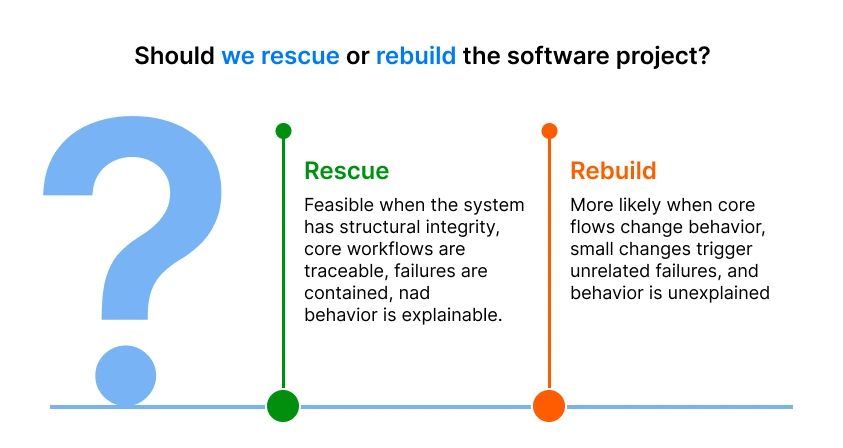
At NetSet Software Solutions, this question usually appears after early fixes stop working and uncertainty starts affecting product decisions. Rescue or rebuild is rarely a technical debate alone.
It is a structural and organizational decision shaped by system behavior, team knowledge, and time pressure. This framework reflects how rescue-versus-rebuild decisions are evaluated in practice. It is not a recommendation model. It is a way to examine the current system without framing either option as a default outcome.
9.1. Structural Integrity of the Existing System
The first criterion is whether the system still has an internal structure that supports change.
Rescue remains feasible when:
- Core workflows can be traced end-to-end
- Failures stay contained within specific areas
- System behavior is explainable with reasonable effort
Rebuild becomes more likely when:
- Core flows change behavior across contexts
- Small changes trigger unrelated failures
- No reliable explanation exists for key behaviors
The question is not whether the code is clean, but whether the system still behaves like a system.
9.2. Knowledge Retention and Transferability
NetSet’s assessments place heavy weight on how much understanding of the system remains available.
Rescue is supported when:
- Design decisions are known or recoverable
- New engineers can be onboarded with guidance
- Gaps can be closed through analysis and testing
Rebuild pressure increases when:
- Critical knowledge left with former developers
- The system depends on undocumented assumptions
- Safe modification is no longer possible
Loss of knowledge often accelerates rebuild discussions faster than technical limits alone.
9.3. Dependency Surface and External Constraints
Most production systems depend on external services and platform behavior.
Rescue tends to align when:
- Dependencies are stable and predictable
- Platform constraints are understood
- Integrations fail in a reproducible way
Rebuild enters the conversation when:
- Dependencies are obsolete or unsupported
- Platform changes are absorbed through workarounds.
- Integration behavior cannot be reliably tested.
External constraints often define how much flexibility either option provides.
9.4. Time Pressure and Risk Distribution
NetSet does not treat time pressure as a deciding factor, but as a risk signal. Rescue concentrates risk into incremental changes while preserving continuity. Rebuild shifts risk into parallel development and delayed validation. Neither option removes risk. They redistribute it.
9.5. Emotional Bias and Decision Distortion
Experience shows that emotion frequently influences this decision.
Common distortions include:
- Attachment to existing code due to past effort
- Overconfidence in the simplicity of a rebuild
- Burnout-driven desire for a clean start
At NetSet Software Solutions, these biases are surfaced explicitly before technical conclusions are drawn.
Decisions anchored in observable behavior tend to remain valid longer than those driven by frustration or optimism.
9.6. Using the Framework
This framework is used to clarify:
- What constraints are technical versus emotional
- Where risk currently resides
- Which trade-offs are consciously accepted
The outcome is not a prescribed answer. The outcome is a decision made with full awareness of its consequences.
That awareness is what prevents avoidable regret later.
10. Software Projects NetSet Commonly Rescues
Most software development project rescue requests don’t start with panic. They start with confusion. Product Owners often notice small signals first. Something works, but no one fully understands why it works or why it suddenly doesn’t.
In mobile app projects, this usually shows up first. The app is live, users are active, but every release feels heavier than the last. Small changes trigger unexpected issues. iOS and Android behave differently, even though the product promise is the same.
Over time, teams stop improving the app and focus only on not breaking it. That’s when founders begin looking for software project and application rescue support. Web applications follow a similar pattern, just at a different scale. These platforms often grow feature by feature, without a pause to realign architecture.
Performance slows. Integrations feel fragile. Dedicated developers take weeks to understand basic flows. At this stage, the product still looks fine from the outside, but internally it resists change.
Common rescue scenarios we see include:
- Mobile apps with unstable release cycles and recurring bugs
- Web applications that have outgrown their original architecture
- Backend systems that no longer match the current business logic
- Admin panels and dashboards are avoided by internal teams
- Projects where the professional developers are no longer available
What connects all these cases is not poorly developed; it’s lost context. Decisions were made quickly, documentation fell behind, and ownership became unclear.
As a software project rescue agency, the real work begins by restoring that context.
Before proposing IT software project rescue solutions, the system has to be understood as it is today, not as it was originally planned. That understanding is usually the turning point that founders have been searching for.
11. Outcomes of a Proper Software Rescue
At NetSet Software Solutions, a proper software rescue is judged by how the system behaves after the work is done, not by how the work is described. The changes are practical and visible in everyday use.
Teams gain a clearer understanding of how the software is structured and why it behaves the way it does. Code quality is easier to follow. When issues appear, causes can be identified directly instead of inferred through guesswork.
Release work becomes more controlled. Features are scoped with realistic effort in mind. Mobile applications show consistent behavior across platforms. Web applications respond in predictable ways under normal usage. Changes stop triggering unrelated failures.
Common observable outcomes include:
- Clear and readable code structure
- Fewer unexpected issues during releases
- Mobile apps with aligned behavior on iOS and Android
- Web applications that remain stable as features evolve
- Reduced reliance on expert developers for system knowledge
Another visible shift is in decision-making. Product and engineering discussions rely on shared context. Trade-offs are understood before changes are made. Less time is spent debating unknowns inside the system.
Documentation improves where it matters, but more importantly, the software itself becomes easier to understand. New team members can follow core flows without constant guidance.
At this stage, the software feels steady. Not perfect, not finished, but understandable. That level of clarity becomes the baseline for every future decision.
12. What NetSet Will Not Do?
At NetSet Software Solutions, trust starts with being clear about what we will not do. These boundaries come from experience, not theory. They exist to protect the software, the team, and the decisions around it. We will not commit to timelines or faster delivery plans before the system is properly understood.
When the internal structure is unclear, certainty is artificial. We do not create confidence where none exists. We will not push for a rebuild simply because the current system is difficult to work with. Difficulty is common. Structural failure is not. That distinction matters and is always examined before any direction is discussed.
There are also clear limits to how we engage during rescue work:
- We do not add new features on top of unstable foundations
- We do not rely on permanent workarounds for known structural issues.
- We do not accept engagements where outcomes are already decided.
- We do not keep critical knowledge confined to a few individuals.
We will not mask uncertainty with optimistic language. If trade-offs are real, they are stated plainly. If risks exist, they are acknowledged without softening. We will not replace internal ownership. Rescue work only makes sense when teams are involved, informed, and able to make decisions with clarity.
These are not rules meant to restrict progress. They are the conditions under which rescue work stays honest and useful. Clear boundaries remove confusion early. That is how NetSet protects trust before anything else.
13. Moving Forward Without Rushing
At NetSet Software Solutions, we see software initiatives enter risk states when signals are missed. Forward progress comes from structured assessment, root cause analysis, and data-driven decisions, enabling controlled remediation rather than rushed actions driven by uncertainty alone.
Some practical ways to proceed steadily include:
- Assess before adjusting: Take note of how the system behaves today, where the risks are, and what patterns emerge.
- Prioritize clarity over speed: Focus on understanding flows and dependencies before making changes.
- Separate urgent from important: Some fixes need attention immediately, but many others can be planned and addressed gradually.
- Incremental steps: Small, consistent changes often reveal more than large, rushed interventions.
- Maintain visibility: Keep track of decisions and their effects so the team can see progress and avoid repeating mistakes.
The goal is not rapid progress; it is steady, informed action. Each step clarifies the system, reinforces the team’s understanding, and reduces risk without adding stress. Over time, decisions become easier, patterns more predictable, and the software itself more navigable.
At NetSet Software Solutions, we intervene to regain momentum in projects that have lost direction. Through successful recovery frameworks, clear execution, and scalable, future-proof engineering methodologies, we become a trusted ally for software project rescue and development.
Our aim is straightforward: to assist businesses in stabilizing failing projects, achieving sustainable growth, and regaining confidence in technology investments.
Frequently Asked Questions (FAQs)
1. How do you know if our software project really needs rescue?
You’ll usually feel it before anyone can diagnose it. Releases take longer than planned, small fixes cause new problems, and your team hesitates to touch the code. If day-to-day development feels unpredictable or fragile, that’s a signal. It doesn’t mean it’s broken beyond repair, just that clarity is missing.
2. Can we just fix parts of the system instead of a full rescue?
Sometimes, yes. We often start with targeted repairs to stabilize critical areas. But we always check if those fixes are sustainable. Temporary patches are okay short-term, but only if you know what they’re covering and why.
3. How long will it take to see improvements?
It depends on the state of the system and your team’s involvement. Usually, the first noticeable shift is clarity, understanding what works, what fails, and why. That often happens in the first few weeks of assessment. Real, lasting improvement comes after the team can make informed changes safely.
4. Will this rescue replace our internal team?
No. We work with your team, not instead of them. Knowledge transfer and shared understanding are central. If your team doesn’t know why a system behaves a certain way, the rescue will show them, not hide it.
5. Do we have to rebuild everything?
Not automatically. The decision to repair or rebuild comes after we understand the system. Many projects can be repaired if the structure and knowledge exist. Rebuilds only happen when repair would be riskier in the long term.
6. How do we avoid this situation again?
There’s no magic fix, but transparency and process clarity help. Keep documentation up to date, make small changes incrementally, and make sure decisions are visible to anyone working on the system. Rescue work usually includes building that visibility, so the next problem is easier to handle.