
The Ultimate Guide to Prediction Market Platform Software (2026)
A prediction market platform is a digital marketplace where users trade on the outcome of future events using contracts whose prices represent probability. Instead of asking people what they think, a prediction marketplace turns conviction into a measurable signal—because participants must commit value (free-to-play or real-value) behind their position.
Example: “Will X happen before Y date?” If the “Yes” contract trades at 0.65, the market is pricing roughly a 65% probability. This guide is built for readers exploring prediction market software development, white label prediction market platforms, and “Polymarket-style / Kalshi-like” marketplaces—without unnecessary jargon or hype. You’ll learn how markets are created, how pricing and settlement work, what legal and compliance factors matter in 2026, and what “ownership” really means when launching a branded product. If you’re deciding whether to build or buy: start here, then jump to:
Build From Scratch vs White-Label What New Founders Must Know Before Launch1. What Is a Prediction Market Platform?
A prediction market converts uncertainty into tradable outcomes. Each market has:
- a question (clearly defined)
- fixed outcomes (Yes/No, multiple choice, ranges),
- an end date/closing condition, and
- resolution criteria (how the outcome will be confirmed).
The platform’s role is not to “predict the future.” It is to provide the market infrastructure—rules, trading mechanisms, risk controls, and settlement—so price discovery can happen reliably.
Core keyword cluster to include on-page: prediction market platform, prediction marketplace software, event contract platform, forecasting marketplace, prediction exchange, outcome trading platform, prediction market website
2. Types of Prediction Market Platforms
Prediction market platforms generally fall into three architecture models: centralized, decentralized, and hybrid. Choosing the right model depends on your jurisdiction, business model, audience, and compliance requirements.
2.1. Centralized Prediction Markets (Operator-Controlled)
A centralized prediction market runs on a company-controlled platform where the operator manages user accounts, custody (if applicable), risk controls, and settlement. These platforms typically deliver faster UX, simpler onboarding, and stronger compliance enforcement—but users rely on the operator’s integrity and systems.
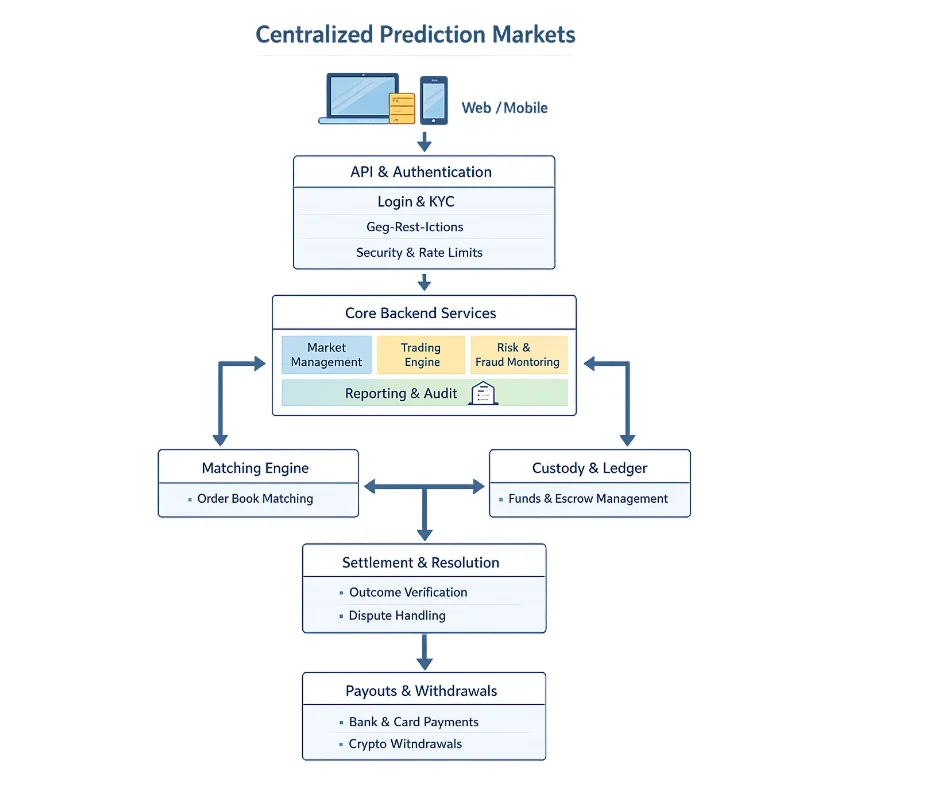
Best for: regulated environments, fiat rails, enterprise controls, controlled user bases
Strengths: speed, KYC/AML support, geo-restrictions, traditional payments
Trade-off: trust is primarily “operator-based,” not protocol-based
Kalshi Polymarket vs Kalshi: Technical Differences That Matter2.2. Decentralized Prediction Markets (On-Chain)
A decentralized prediction market runs on blockchain using smart contracts market creation, trading/position accounting, and settlement. These systems can provide transparency and composability (wallet-based access), but depend heavily on liquidity and reliable oracles for outcome resolution. Regulatory complexity may also increase depending on region and market structure.
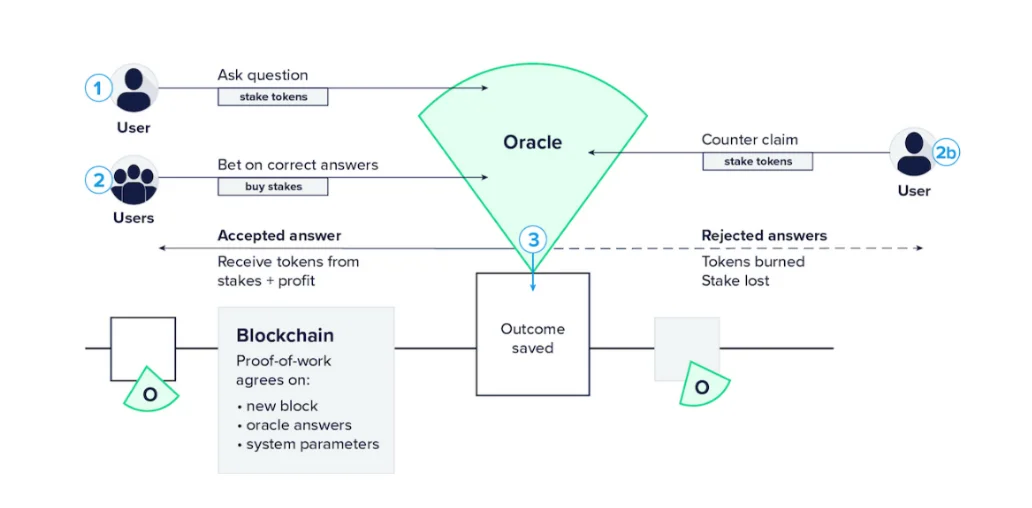
Best for: Web3-native ecosystems, permissionless participation models
Strengths: non-custodial access, transparent settlement, global distribution
Trade-off: UX friction, oracle dependence, complex compliance in some regions
Augur Most Popular Prediction Market Platforms in 20262.3. Hybrid Prediction Markets (Most Practical for Scale)
A hybrid prediction market platform combines a centralized experience (fast UI, off-chain matching, compliance tooling) with on-chain settlement or verifiable finalization. This approach aims to deliver exchange-like performance while keeping settlement transparent and auditable.
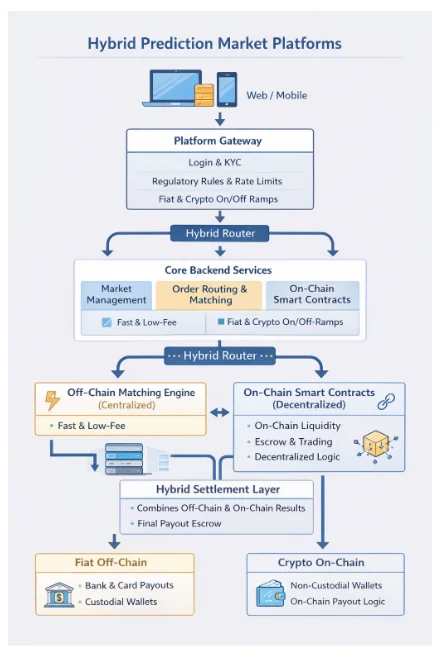
Best for: high-volume platforms, cross-region strategies, “enterprise-grade” reliability
Strengths: performance + transparency balance, scalable operational model
Trade-off:architecture is more complex than pure centralized or pure on-chain
Polymarket Polymarket vs Kalshi: Technical Differences That Matter3. Most Popular Prediction Market Platforms in 2026
Only a handful of prediction marketplaces have achieved meaningful adoption, liquidity, and brand recognition. In practice, the "mainstream" ecosystem is shaped by two leaders plus a small set of known Web3 protocols
3.1. Market Leaders by Adoption & Activity
Polymarket hybrid model, high engagement across real-world event markets
Kalshi centralized and regulated in the U.S., focused on event contracts
3.2. Well-Known Decentralized Protocols (Ecosystem References)
Augur early on-chain protocol, foundational reference for decentralized market design
Omen (Gnosis ecosystem) popular in Web3 communities and DAO-style forecasting
4. What Polymarket Really Is (and Why People Trust This Model)
Many people assume Polymarket "predicts outcomes." It doesn't. A Polymarket-style prediction market measures conviction—how strongly participants believe something will happen—because participation has consequences.
This is why prediction markets often feel more reliable than:
- polls,
- surveys,
- social media sentiment, or
- expert commentary.
A Polymarket-style platform works because it is structured:
- markets are defined clearly,
- outcomes are fixed,
- settlement rules are disclosed upfront, and
- prices move based on real trades—not editorial decisions.
5. Why Prediction Marketplaces Build Trust and Gain Adoption Faster Than Traditional Betting
Prediction marketplaces are gaining traction because they solve a trust and information problem. They behave more like a market (probability discovery) than a sportsbook (odds setting).
5.1. From "House Odds" to Market-Discovered Probability
Traditional betting uses operator-set odds; users are effectively betting against the house. Prediction markets replace operator control with market pricing, which updates continuously as new information enters the system.
5.2. Incentives Reward Accuracy, Not Popularity
Prediction markets pay for being right. Incorrect positions lose value. This naturally discourages noise and rewards accurate forecasting without needing "moderation" like social platforms.
5.3. Transparent Rules + Deterministic Settlement
Markets publish rules upfront: outcomes, closing time, resolution sources, settlement logic. Clear settlement reduces disputes and increases repeat participation.
5.4. Neutral Revenue Model (Less Conflict of Interest)
Unlike sportsbooks, prediction marketplaces can be designed so operators earn primarily from transaction fees, market sponsorship, subscriptions, and data/analyticsnot from users being wrong.
How Prediction Market Platforms Make Money5.5. Broader Use Cases Beyond Gambling
Prediction market software is increasingly used for:
- forecasting economic indicators
- market sentiment
- enterprise decision support
- media engagement
- research and collective intelligence
This expands adoption well beyond "betting users."
6. Who Uses Prediction Market Platforms and Why
Prediction market platforms are specialized decision and forecasting systems, not mass-market entertainment products. They deliver value only when applied to clearly defined questions, genuine uncertainty, and participants willing to engage with outcomes through measurable risk rather than opinion.
This focus is intentional. Prediction markets are designed for specific use cases and users, and attempting to apply them universally often leads to poor outcomes. Clarifying who these platforms are designed for is essential to setting the right expectations, managing risk, and ensuring the model is used where it creates real value.
At a strategic level, prediction market platforms serve two distinct stakeholder groups:
- Platform operators, who design, govern, and scale the marketplace, and
- Market participants, whose trading activity generates the probability signals the platform exists to produce.
Each group has different objectives, incentives, and risk exposure. Successful prediction market platforms are those that balance the needs of both while maintaining transparency, predictable settlement, and operational control.
6.1. Platform owners and operators
These are the businesses and organizations building or launching a prediction market platform. For them, the value is not betting; it's insight, engagement, and control.
Prediction markets make sense for:
- Startups and founders test ideas, user behavior, or market sentiment
- Enterprises are looking for internal forecasting and decision support
- Media companies create interactive, data-driven audience engagement
- Research and analytics teams gathering probability-based insights
- Sports, finance, and event platforms are adding prediction layers to their existing products
For these operators, ownership matters. That's why many choose private prediction market platforms instead of public networks. They want control over rules, participants, data, and compliance.
6.2. End users and participants
On the user side, prediction markets attract people who care about outcomes and are comfortable making probability-based decisions.
Typical participants include:
- Informed users who follow specific domains like sports, finance, or politics
- Analytical thinkers who prefer data-backed decisions over speculation
- Communities and fan bases engage with events in real time.
- Internal teams contribute forecasts in controlled environments.
What keeps these users engaged is fairness. Clear rules, transparent pricing, and predictable settlement matter more than flashy features.
7. How Prediction Markets Work?
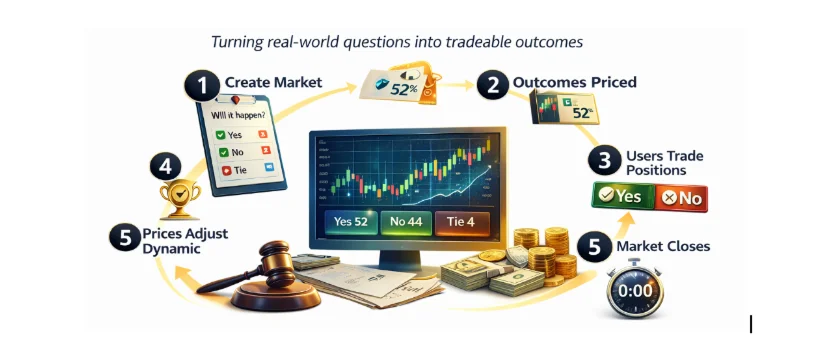
A prediction market works by turning real-world questions into tradeable outcomes. Instead of asking for opinions, the platform lets users place positions on what they believe will happen. The collective activity of users creates a probability signal.
Here's how the process works in practice:
- A market is created around a specific question with clearly defined outcomes, timelines, and resolution rules.
- Each outcome is priced based on current demand, reflecting its perceived probability.
- Users place trades by choosing an outcome and committing value, either in free-to-play or real-value formats.
- Prices move automatically as more trades are placed, adjusting probabilities in real time.
- Trading continues until the market reaches its closing condition or end date.
- The final outcome is verified using predefined data sources or resolution criteria.
- Winning positions are settled automatically, based on the final market result.
- All activity is recorded and visible through the platform's admin and reporting systems.
What makes prediction markets effective is incentive alignment. Users are rewarded for being accurate, not popular. Incorrect positions lose value, while correct ones gain. For platform operators, this model provides:
- Transparent market behavior
- Real-time insight into collective expectations
- Controlled participation and settlement
- Scalable operation across multiple markets
When built with clear rules and reliable settlement logic, prediction markets become structured tools for forecasting, engagement, and decision-making, not speculation engines.
8. How Smart Contracts Run a Prediction Market?
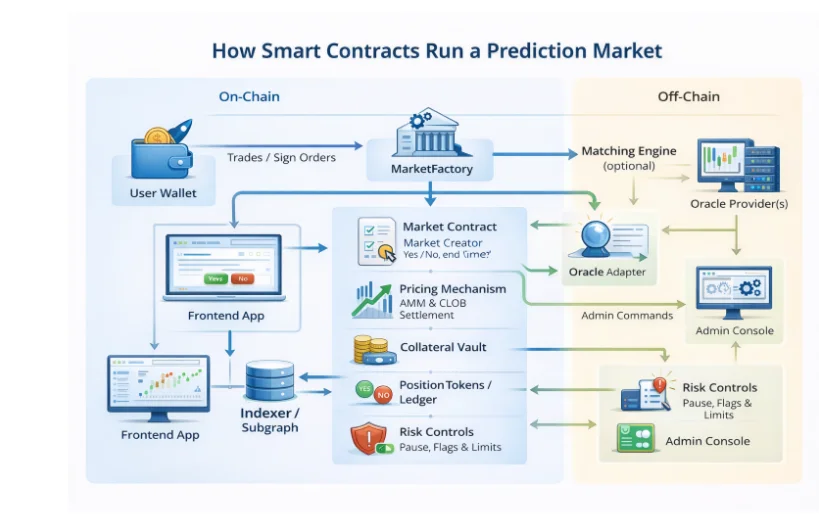
Smart contracts act as the operational backbone of a prediction market platform. They define how the system behaves once a market goes live, without relying on manual control.
Here's how they actually work in practice:
- Set clear rules for market creation, trading, and closure
- Lock trading automatically when the event deadline is reached
- Adjust market prices based on real-time user participation
- Record every trade transparently for audit and tracking
- Prevent late entries or rule manipulation
- Trigger a settlement only after the outcome is confirmed.
- Distribute payouts fairly based on predefined logic
Why this matters to users and platform owners:
- Users trust the platform because rules are enforced consistently.
- Operators reduce risk, errors, and operational overhead.
- Markets run smoothly across different regions and event types.
- Platforms remain scalable without constant monitoring
This automation is what allows prediction market websites like Polymarket to operate rseliably, even at scale.
9. The Economics Behind Prediction Market Platforms
Prediction market platforms function as economic systems designed to aggregate information through incentives. Their effectiveness does not depend on forecasts or opinions, but on how well they align participant behavior with accurate outcome discovery. Four economic components determine whether a prediction market succeeds or fails: liquidity, incentives, pricing mechanics, and operator revenue structure.
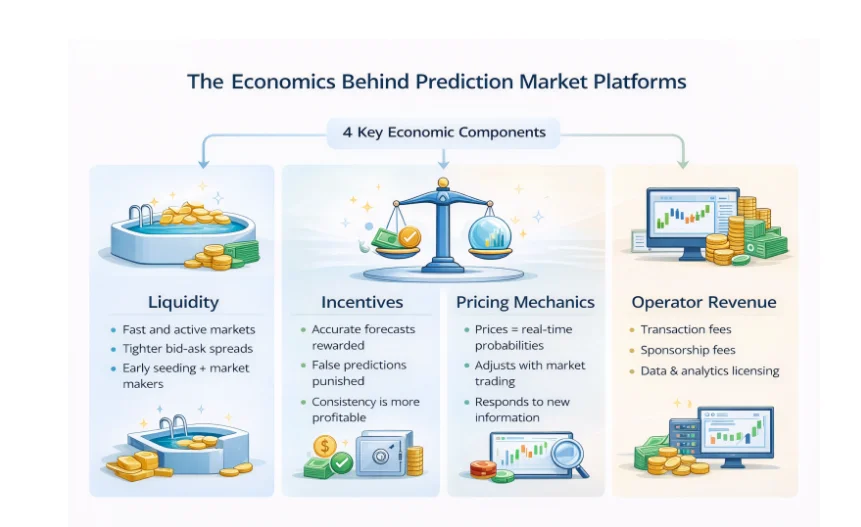
9.1. Liquidity: The Foundation of Reliable Markets
Liquidity determines whether a prediction market produces meaningful signals or stagnates. Without sufficient liquidity, prices fail to reflect real probabilities, participants disengage, and markets become unreliable.
High-functioning prediction markets ensure:
- Continuous ability to buy and sell positions
- Minimal price distortion from individual trades
- Active participation across market lifecycles
Liquidity is typically supported through a combination of:
- Early market seeding by operators or sponsors
- Market makers or automated liquidity mechanisms
- Concentrated focus on fewer, high-quality markets rather than excessive breadth
Markets with healthy liquidity generate faster price discovery, higher trust, and repeat participation.
9.2. Incentives: Why Accuracy Wins Over Popularity
Prediction markets succeed because they reward being correct, not being loud or influential. Participants who consistently take accurate positions gain value, while incorrect positions lose value over time.
This incentive structure:
- Penalizes misinformation naturally
- Encourages participants to seek better data
- Aligns personal outcomes with collective accuracy
Unlike traditional opinion platforms or betting systems, prediction markets do not require moderation to surface quality insights. The economic design itself filters noise and amplifies credible signals.
9.3. Pricing: Probability as a Market Signal
In prediction markets, price is not an arbitrary number it represents a real-time probability estimate generated by participant activity. Each trade adjusts the price based on supply and demand, continuously updating the market's collective belief.
Effective pricing mechanisms:
- Reflect changing information in real time
- Allow rapid correction when new data emerges
- Prevent static or operator-controlled odds
Whether implemented through order books, automated market makers, or hybrid models, pricing must remain transparent, responsive, and resistant to manipulation to preserve trust.
9.4. Operator Revenue: Neutral Facilitation, Not Outcome Bias
Unlike traditional betting platforms, prediction market operators are not incentivized to influence outcomes. Instead, they act as neutral facilitators of markets.
Common revenue models include:
- Transaction or trading fees
- Market creation or sponsorship fees
- Platform subscriptions or enterprise licensing
- Value-added analytics or reporting services
This separation between platform revenue and user losses is critical. It reduces conflicts of interest, increases credibility, and enables long-term adoption particularly among institutional and enterprise users.
Why This Economic Model Scales
Prediction market economics scale because they:
- Convert uncertainty into measurable signals
- Self-correct through financial incentives
- Function across diverse domains and market sizes
- Remain resilient without heavy central intervention
When liquidity, incentives, pricing, and revenue structures are properly balanced, prediction markets evolve from speculative tools into reliable forecasting and decision-support systems.
10. How Do Prices Change and Markets Stay Active?
In a prediction market, prices don't move randomly. They change because people keep reacting to new information, and that's precisely what keeps the market alive.
Here's the easiest way to understand price movement:
- Each outcome has a price that reflects how likely people think it is. If the price of "Yes" on a question is 65%, the market collectively believes there's a 65% probability that outcome will happen.
- When more users buy one outcome, its price goes up. Higher demand signals increased confidence. If more participants buy "Yes," the price might move from 65% to 72%, reflecting growing conviction.
- When users sell or stop buying, the price comes down. Reduced demand or increased selling pressure lowers the perceived probability.
- New information (news, updates, rumors) pushes people to trade again. A breaking news headline, a policy announcement, or a major event update can trigger immediate trading activity, causing prices to adjust rapidly.
Think of the price as a live opinion meter, not a fixed number.
What keeps the market active over time?
- Continuous buying and selling from different users. An active market requires diverse participants with different perspectives, information sources, and risk tolerances.
- Both small traders and large traders influence prices. While large traders can move markets significantly, small traders collectively contribute to price discovery and market depth.
- Time pressure as the event date gets closer. As deadlines approach, uncertainty resolves, information becomes clearer, and participants adjust positions accordingly.
- Platform incentives like liquidity support or visibility. Rewards for market makers, featured markets, or promotional incentives help maintain continuous activity even during low-interest periods.
Why does this matter to users?
- Users can enter and exit anytime before the market closes. Unlike traditional betting where positions are locked, prediction markets offer flexibility to adjust positions as new information emerges.
- Early participants benefit from spotting trends earlier. Those who identify undervalued outcomes before the broader market can capture greater returns as prices correct.
- Late participants react to fresh updates. Even near the end of a market's lifecycle, breaking news can create profitable trading opportunities for informed participants.
This constant interaction is what makes prediction markets dynamic instead of stagnant.
11. What Can Go Wrong If You Launch Without Proper Planning?
Launching an own prediction market platform without solid planning often looks fine on day one, but problems start showing up fast. Most failures don't happen because the idea is bad. They happen because the groundwork is weak.
Without a clear plan, technical, legal, and user-trust issues pile up together, and fixing them later costs far more than doing it right from the start.
Common problems teams run into:
11.1. Low user trust
Users hesitate to trade if rules, payouts, or platform logic feel unclear or inconsistent.
What causes this:
- Vague or inconsistent market resolution criteria
- Unclear settlement processes or delayed payouts
- Lack of transparent audit trails or transaction history
- Platform operators making arbitrary rule changes mid-market
The impact: Users won't participate or commit real value if they don't trust the outcome will be fair. Without trust, markets stay empty regardless of how good your technology is.
11.2. Liquidity collapse
Markets look empty when early participation isn't planned, making prices unreliable and discouraging new users.
What causes this:
- Launching too many markets simultaneously without focus
- No liquidity seeding or market maker strategy
- Insufficient user acquisition before launch
- Markets on topics with little genuine interest or uncertainty
The impact: Empty markets create a negative feedback loop. Low liquidity means wide spreads and poor pricing, which discourages trading, which further reduces liquidity. Markets become stagnant and participants leave.
11.3. Technical breakdowns under load
Platforms that aren't stress-tested fail during peak events, causing trade delays or incorrect settlements.
What causes this:
- Insufficient load testing before public launch
- Poor database architecture that can't handle concurrent trades
- Lack of proper error handling and recovery mechanisms
- No monitoring or alerting systems for critical failures
The impact: System failures during high-traffic events destroy credibility instantly. Users experiencing failed trades, frozen accounts, or incorrect settlements will abandon the platform and warn others publicly.
11.4. Legal exposure
Ignoring regional regulations can lead to forced shutdowns, payment freezes, or blocked markets.
What causes this:
- Operating without understanding local gambling or financial regulations
- No KYC/AML compliance where legally required
- Accepting users from restricted jurisdictions
- Failing to obtain necessary licenses or registrations
The impact: Regulatory enforcement can shut down your platform overnight, freeze user funds, or result in significant fines. Recovery from legal shutdowns is nearly impossible, and user trust is permanently damaged.
11.5. Poor user experience
Confusing interfaces and unclear flows make beginners drop off within minutes.
What causes this:
- Overly complex onboarding without clear guidance
- Confusing terminology without explanations for new users
- Cluttered interfaces that hide essential functions
- Slow page loads or unresponsive mobile experience
The impact: Most users decide within the first few minutes whether to stay or leave. Poor UX means high bounce rates, low conversion, and wasted acquisition costs. Even if your backend is solid, users won't stay long enough to discover it.
11.6. Cost overruns
Rushed development leads to constant fixes, redesigns, and higher long-term expenses.
What causes this:
- Building without clear technical specifications
- Choosing wrong architecture that requires complete rebuilds
- Underestimating integration complexity (payments, oracles, compliance)
- No contingency budget for inevitable issues
The impact: Projects that rush to market often spend 2-3x their initial budget on emergency fixes, technical debt, and rebuilds. Cost overruns drain runway, delay critical features, and can force platforms to shut down before reaching profitability.
The real risk:
Once users lose confidence, they don't come back, even if you later fix everything.
Proper planning isn’t about slowing down. It’s about launching once, and launching right.
12. Failure Reasons + Survival Checklist
Most prediction markets collapse early not because the idea is flawed, but because the fundamentals are ignored. When you compare failed platforms with the ones that survive, the gaps are very clear.
| Area That Matters | Markets That Fail Early | Markets That Survive |
|---|---|---|
| Liquidity Planning | Assume users will trade automatically | Seed liquidity and attract early market makers |
| User Acquisition | No clear growth or onboarding strategy | Clear funnels, incentives, and education |
| Market Questions | Vague or poorly framed outcomes | Simple, binary, easy-to-understand questions |
| Trust & Transparency | Unclear settlement rules | Predefined, visible, and enforced rules |
| Compliance Awareness | Ignore legal boundaries until problems arise | Design markets around allowed jurisdictions |
| User Experience | Confusing flows and too many steps | Simple first trade in under a minute |
| Post-Launch Strategy | Launch and move on | Actively monitor, adjust, and improve markets |
| Retention Focus | No reason for users to return | Notifications, recurring markets, incentives |
The reality check:
Prediction markets are not "set and forget" products. They only work when liquidity, trust, and usability grow together.
If even one of these pillars is missing, users lose confidence, and once confidence is gone, the market dies quietly.
13. Legal & Compliance for Launching Prediction Marketplace in your country
In 2026, prediction markets are explicitly regulated in some regions, restricted or prohibited in others, and closely monitored almost everywhere.
Most confusion comes from blending technology with law. Blockchains, smart contracts, or tokens don't determine legality, regulators do.
Let's break this down clearly, without legal jargon.
The core legal question regulators ask
Regulators don't ask, "Is this a prediction market?"
They ask:
- Does this process look like gambling?
- Does it resemble financial trading or derivatives?
- Are users risking real money on uncertain outcomes?
- Who controls settlement and dispute resolution?
Your answers decide legality.
Legal status by region (2026 reality check)
13.1. United States
Real-money prediction markets are heavily restricted.
- Markets involving cash payouts typically fall under CFTC oversight.
- Platforms like Kalshi operate as CFTC-approved Designated Contract Markets (DCMs).
- Unlicensed real-money markets are treated as illegal off-exchange derivatives or gambling.
- Most commercial platforms:
- Block US users entirely, or
- Offer free-to-play, research, or incentive-only markets.
Required license (if real money):
- CFTC approval (DCM or no-action relief)
13.2. Europe
There is no single EU rule, regulation is country-specific.
- Some countries classify prediction markets as online gambling (requiring national gambling licenses).
- Others treat them as financial instruments under MiFID II, triggering securities regulation.
- The UK generally places them under UK Gambling Commission rules unless structured as financial contracts.
Common requirements:
- KYC/AML compliance
- Geo-blocking for restricted jurisdictions
- Transparent settlement and dispute procedures
- Consumer protection measures
13.3. Asia & Middle East
This region is the most restrictive overall.
- Many countries prohibit real-money betting on future events, regardless of technology.
- Crypto-based prediction markets are often treated as illegal wagering
- Most activity is limited to:
- Free-to-play
- Research or incentive-only simulations
Internal enterprise forecasting
Licensing reality:
Often unavailable or impossible for public real-money markets
13.4. Global platforms
- Often restrict access by geo-blocking
- Run different market types based on user location
Key takeaway: There is no "globally legal" setup. Compliance is regional.
Real-money vs free-to-play (this matters a lot)
| Model | Legal Risk | Notes |
|---|---|---|
| Free-to-play (F2P) | Low | No real money, often legal everywhere |
| Token-based (non-cash) | Medium | Depends on token utility |
| Real-money markets | High | Requires licensing or exemptions |
This is why many platforms start with free-to-play and expand carefully.
What usually makes a platform illegal?
Most platforms don't fail legally because of the idea, but because of execution.
Common mistakes:
- Allowing real-money trades without licenses
- Poorly defined settlement rules
- Mixing speculative finance with betting mechanics
- Ignoring jurisdiction-based access control
Can a Polymarket-style platform be compliant?
Yes, but only if it's designed correctly from day one.
Compliant setups usually include:
- Clear market definitions
- Transparent settlement logic
- Geo-restrictions
- Flexible market modes (F2P + real money)
- Admin-level control over markets and users
This is where platform architecture matters more than marketing.
Who should be extra careful?
If you're planning to launch a prediction marketplace:
- Startups targeting global users
- Platforms offering financial or political markets
- Anyone allowing real-money participation
If this is you, compliance planning isn't optional, it's survival.
14. Polymarket vs Kalshi: Technical Differences That Actually Matter
On the surface, Polymarket and Kalshi look similar, both let users trade on real-world outcomes. But under the hood, they are built very differently.
And those technical choices affect trust, scalability, compliance, and who can legally use the platform.
Core technical comparison
| Aspect | Polymarket | Kalshi |
|---|---|---|
| Architecture | Blockchain-based (smart contracts) | Centralized infrastructure |
| Settlement Logic | On-chain, automated | Off-chain, regulator-approved |
| Custody of Funds | Non-custodial (user wallets) | Custodial (platform-managed) |
| Regulatory Approach | Avoids heavy licensing via decentralization | Fully regulated (CFTC-approved in the US) |
| Market Creation | Permissioned but flexible | Strictly controlled |
| User Access | Global (with geo-restrictions) | Primarily US-based |
| Transparency | Public, verifiable on-chain | Trust-based, internal systems |
| Speed & UX | Depends on blockchain conditions | Faster, traditional UX |
What do these differences mean in real life?
Polymarket is built for openness and transparency. Trades, prices, and settlements live on-chain, which reduces manual intervention.
This attracts crypto-native users but adds blockchain complexity and legal gray areas in some regions.
Kalshi, on the other hand, prioritizes regulation. Everything is centralized, reviewed, and compliant with US financial laws. That makes it slower to expand globally, but far safer legally.
Which model suits which business?
1. Choose a Polymarket-style platform if:
- You want global reach
- You prefer transparent, automated settlement
- You're comfortable managing blockchain infrastructure
2. Choose a Kalshi-style platform if:
- You target regulated markets like the US
- Compliance matters more than decentralization
- You want traditional finance-grade controls
The honest takeaway:
There's no "better" platform, only better alignment with your goals. The smartest teams don't copy Polymarket or Kalshi blindly. They combine the strengths of both.
15. Cost to Build a Prediction Market Platform (Polymarket-Style or Kalshi-Like)
The cost to build a Prediction Market Platform in 2026 really depends? Building a Polymarket-style or Kalshi-Like prediction market platform starts from 25000 USD to 120,000+ USD
The cost depends on what you build first, what you automate, and how much risk you plan for. Below is the step-by-step cost reality, explained simply.
Step 1: Product Planning & Market Design
What you pay for: thinking before coding
This stage defines:
- Market types (sports, finance, politics, events)
- Free-to-play vs real-money logic
- Settlement rules and dispute handling
- Geo-rules and access controls
Cost range: $3,000 – $8,000
Skipping this step is why most platforms fail early.
Step 2: Core Platform Development
What you pay for: the actual engine
Includes:
- Market creation logic
- Trading & price movement system
- User accounts and balances
- Admin controls
Cost range: $20,000 – $45,000
This is the backbone, cutting corners here breaks trust.
Step 3: Smart Contract or Rule Engine Setup
What you pay for: automation and fairness
Covers:
- Outcome logic
- Trade validation
- Automated settlements
- Tamper-proof rules
Cost range: $8,000 – $20,000
Blockchain or not, automation is non-negotiable.
Step 4: Wallets, Payments & Fund Flow
What you pay for: money movement
Includes:
- Wallet integration or internal ledger
- Deposit & withdrawal logic
- Transaction tracking
- Security layers
Cost range: $6,000 – $15,000
This is where user trust is won or lost.
Step 5: Security, Compliance & Geo Controls
What you pay for: survival
Includes:
- Role-based admin access
- Geo-blocking and region rules
- Audit logs
- Risk monitoring
Cost range: $5,000 – $12,000
Ignoring this leads to shutdowns, not growth.
Step 6: Frontend, UX & Mobile Responsiveness
What you pay for: user retention
Includes:
- Web interface
- Mobile optimization
- Clear price and outcome views
Cost range: $6,000 – $15,000
Ugly platforms don't retain users.
Step 7: Testing, Deployment & Launch Readiness
What you pay for: avoiding disasters
Includes:
- Load testing
- Market simulation
- Settlement testing
- Go-live setup
Cost range: $3,000 – $7,000
Final Reality Check: Total Cost Range
$25,000 to $120,000+, depending on:
- Real-money vs free-to-play
- Compliance depth
- Blockchain usage
- Global reach
16. How Prediction Market Platforms Make Money Revenue Pathways and Real-World Examples
Prediction market platforms are not just forecasting tools they are economic engines with multiple revenue streams. Unlike traditional betting platforms that profit primarily from odds margins, modern prediction marketplaces generate revenue by facilitating markets, charging fees, and monetizing real-time probability data. Understanding these pathways helps explain why this sector is seeing rapid investment and wider adoption.
16.1. Transaction Fees The Core Revenue Driver
Most prediction markets charge a fee on trades executed on the platform, similar to a brokerage or exchange model. Every time a user buys or sells a contract representing an outcome, a fee is collected.
- Kalshi charges a transaction fee on the expected earnings of a contract, reinforcing neutrality and fairness.
- Polymarket also earns revenue through transaction fees, typically paid in stablecoins like USDC. Higher trade volumes directly increase this revenue stream.
This model scales automatically: more users and more trades mean more fee income.
16.2. Market Creation Fees
Platforms may charge fees when new prediction markets are created. This not only prevents spam but also captures value from event creators who want to list high-interest markets.
Although not always a primary revenue source today, market creation fees can contribute meaningfully as platform usage grows.
16.3. Liquidity & Spread Economics
High-volume prediction markets often rely on liquidity providers to ensure users can trade easily without large price slippage. Platforms may share a small portion of the spread or fees with these providers, but the structure can also benefit the operator.
- Platforms earn indirectly through spreads when liquidity is deep and markets are efficient.
- Better liquidity attracts more traders, reinforcing transaction fee growth.
16.4. Data Monetization and Institutional Licensing
One of the fastest-growing revenue streams is selling real-time probability data and analytics:
- Predictions reflect the collective view of future events, making them valuable to media outlets, financial institutions, and research teams.
As demand for probabilistic signals increases, data licensing can become a significant income source.
16.5. Premium Features and Loyalty Programs
Platforms are experimenting with premium tiers and VIP programs to increase lifetime user value:
- Kalshi introduced Kalshi Platinum, offering high-volume traders special benefits like dedicated support and rewards.
- Such programs mirror models used in proven financial and trading products.
These efforts help differentiate offerings and generate recurring revenue beyond basic transaction fees.
17. Real-World Revenue Trends: Polymarket and Kalshi
Kalshi
Kalshi has shown strong revenue growth tied to deep liquidity and high trading activity:
- Estimates suggest Kalshi generated approximately $24 million in revenue in 2024, up more than tenfold from the prior year, driven by volume surges.
- The platform now handles billions in monthly trading volume, particularly in sports markets, amplifying fee income.
This demonstrates how regulated, high-volume markets can convert activity into substantial revenue.
Polymarket
Polymarket's revenue profile is evolving:
- The platform often operates with minimal or zero direct trading fees on its global venue, instead benefiting from network fees and ecosystem activity.
- Polymarket's regulatory move into a U.S. venue includes plans for ultra-low trading fees, aligning with long-term growth.
- Major institutional investment (e.g., a reported $2 billion commitment from Intercontinental Exchange) underscores the data and platform value.
18. Who Should Build Their Own Branded Prediction Marketplace and Why It Works
Building a branded prediction marketplace is not about copying existing platforms. It is about owning a forecasting and engagement layer that aligns directly with your audience, data, and decision-making needs. This model works best for organizations that already control attention, expertise, or domain-specific uncertainty.
18.1. iGaming & Interactive Platform Operators
These buyers want:
- New engagement formats beyond betting
- Free-to-play tournaments or real-money markets
- Faster launches without regulatory chaos
They use prediction market software to increase retention and session time without rebuilding from scratch.
18.2. Media, Content & Community Platforms
Media companies buy prediction market platforms to:
- Turn audiences into participants
- Run event-based or opinion-driven markets
- Monetize attention during live moments
For them, prediction markets are an engagement engine, not gambling.
18.3. Financial Research & Analytics Firms
These teams use prediction markets to:
- Forecast economic or market outcomes
- Aggregate crowd intelligence
- Support internal decision-making
Accuracy and auditability matter more than hype here.
18.4. Enterprises & Internal Strategy Teams
Large organizations buy private prediction markets to:
- Run internal forecasting
- Measure confidence in decisions
- Reduce bias in planning
These platforms are often private, invitation-only, and data-driven.
18.5. Web3 & Product-First Founders
These founders already understand:
- Market mechanics
- Token or incentive models
- Long-term platform ownership
They're buying infrastructure, not experiments.
The common pattern across all buyers
They want:
- Full ownership and white-label control
- Predictable costs and timelines
- Compliance-ready, scalable systems
19. Build From Scratch vs White-Label: Choosing the Right Approach
Launching a prediction marketplace is not just a technical decision it is a time-to-market, risk, and capital allocation decision. The right approach depends on your objectives, regulatory exposure, and urgency.
19.1. Option 1: Developing From Scratch
Building from scratch means designing the platform architecture, market logic, settlement engine, UX, compliance controls, and infrastructure entirely in-house or via a custom development partner.
Best suited for
- Enterprises with unique or complex requirements
- Regulated markets with strict compliance needs
- Platforms requiring deep integrations or proprietary logic
- Long-term infrastructure investments
Advantages
- Full control over architecture and roadmap
- Custom market design and settlement logic
- Strong IP ownership and differentiation
Trade-offs
- Longer time to market
- Higher upfront cost
- Greater execution and regulatory risk
- Requires experienced domain knowledge
This approach works best when prediction markets are core infrastructure, not an experiment.
19.2. Option 2: White-Label Prediction Marketplace Software
White-label solutions provide a ready-to-deploy platform that can be branded, configured, and launched quickly often with proven market logic and settlement workflows already in place.
Best suited for
- Startups and founders validating market demand
- Media, communities, and engagement platforms
- Organizations entering prediction markets for the first time
- Teams prioritizing speed and learning over customization
Advantages
- Faster launch (weeks instead of months)
- Lower upfront investment
- Battle-tested market mechanics
- Reduced technical and operational risk
Trade-offs
- Limited deep customization initially
- Dependency on vendor roadmap (unless source access is included)
For most first-time operators, white-label is the lowest-risk entry point.
19.3. Strategic Recommendation
For the majority of new prediction marketplaces, the most effective strategy is:
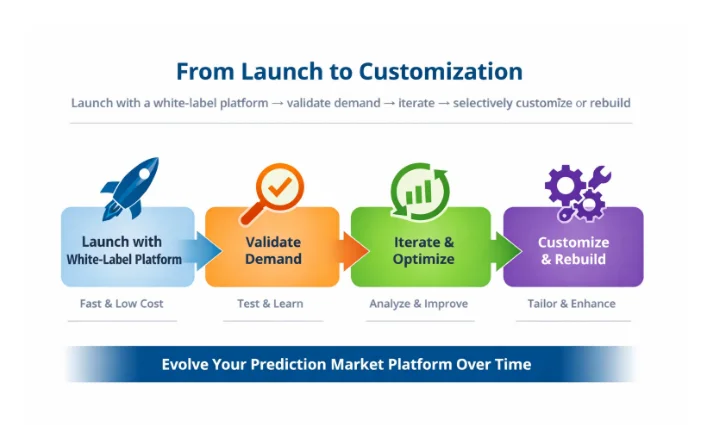
Launch with a white-label platform → validate demand → iterate → selectively customize or rebuild components over time
This phased approach preserves capital, accelerates learning, and avoids over-engineering before product-market fit is proven.
20. What New Prediction Marketplace Founders Must Know Before Launch
Launching a prediction marketplace without understanding these fundamentals is the most common reason platforms fail early.
20.1. Market Design Matters More Than UI
Clear, well-defined questions and outcomes are critical. Vague markets destroy trust and liquidity.
You must define
- Precise outcome criteria
- Clear timelines and closing conditions
- Objective resolution sources
If users cannot understand how a market resolves, they will not participate.
20.2. Liquidity Is Not Automatic
Markets do not become active simply because they exist.
Plan for
- Initial liquidity seeding
- Market makers or automated liquidity models
- Fewer high-quality markets rather than many empty ones
Liquidity strategy should be part of launch planning not an afterthought.
20.3. Settlement and Trust Are Non-Negotiable
Settlement logic must be predictable, transparent, and enforced consistently.
Users expect
- No rule changes after launch
- Clear dispute resolution processes
- Verifiable outcomes
Trust once lost is nearly impossible to regain.
20.4. Compliance and Jurisdiction Cannot Be Ignored
Prediction marketplaces sit at the intersection of finance, gaming, and data regulation.
Before launch, you must decide
- Free-to-play vs real-value markets
- Geo-restrictions and access controls
- KYC/AML requirements (if applicable)
Many successful platforms start with restricted or private markets to reduce risk.
20.5. Incentives Shape Behavior
Prediction markets work only when incentives reward accuracy not volume, hype, or influence.
Design incentives to
- Penalize incorrect positions
- Reward consistent accuracy
- Discourage manipulation and wash trading
Poor incentive design leads to noisy, unreliable markets.
20.6. Revenue Should Be Neutral
Operators should not profit from users being wrong.
Sustainable platforms generate revenue through:
- Transaction fees
- Market creation or sponsorship
- Data and analytics licensing
- Enterprise or private deployments
Neutral revenue models increase long-term trust and institutional adoption.
21. The Future of Prediction Market Platforms: Innovation, Roadmaps, and Build Strategy
Prediction market platforms are no longer niche trading experiments. They are evolving into forecasting infrastructure systems designed to aggregate collective intelligence and convert uncertainty into actionable probability signals.
The next generation of prediction marketplace software will be defined not by who lists the most markets, but by who builds platforms that balance trust, compliance, liquidity, and distribution at scale.
This section explains where prediction market platforms are headed, what innovations are expected, and how founders and businesses should structure their build roadmap including when to use white-label software versus custom development.
From Trading Apps to Decision Infrastructure
The most important shift underway is conceptual.
Prediction marketplaces are moving away from being perceived as betting platforms and toward becoming decision-support systems used by:
- Media organizations embedding probability signals into coverage
- Enterprises running internal forecasting markets
- Research and analytics teams measuring confidence and uncertainty
- Product teams testing real-world outcomes
The platforms that win long-term will not be those with the most speculative markets, but those whose probability outputs become trusted inputs into workflows, dashboards, and products.
Innovation to Expect
- Probability feeds delivered via APIs, widgets, and embeds
- Enterprise and private prediction markets for internal use
- Fewer novelty markets, more structured and measurable outcomes
Prediction markets are becoming infrastructure not entertainment.
Regulated vs Permissionless: A Permanent Industry Split
The prediction market ecosystem is solidifying into two parallel tracks:
1. Regulated, centralized platforms
- Compliance-first
- Jurisdiction-specific
- Suitable for real-money event contracts and institutional use
2. Permissionless or global platforms
- Crypto-native or hybrid
- Focused on transparency and accessibility
- Often restricted or geo-fenced depending on region
This split is not temporary. It will shape product architecture, monetization models, and growth strategies going forward.
Innovation to Expect
- Expansion of regulated, Kalshi-style platforms via partnerships
- Geo-aware market modes (free-to-play in restricted regions, real-value where allowed)
- Stronger governance, auditability, and dispute resolution frameworks
Platforms that ignore this split will struggle to scale safely.
Hybrid Architecture Becomes the Default
Purely on-chain systems face performance limits. Fully centralized systems face trust and transparency challenges. The industry is converging on hybrid architecture as the most scalable solution.
Hybrid platforms combine:
- Off-chain matching or execution for speed and UX
- On-chain or verifiable settlement for transparency and auditability
This approach supports both scale and credibility.
Innovation to Expect
- Exchange-grade APIs and developer tooling
- Faster CLOB-style execution with deterministic settlement
- Advanced liquidity tooling (maker incentives, rebates, dynamic fees)
Hybrid architecture is quickly becoming the standard for serious prediction marketplaces.
Market Design Innovation: Beyond Simple Yes/No
The future of prediction markets is not about volume it's about market quality.
Next-generation platforms will focus on:
- Conditional markets ("if X happens, will Y happen?")
- Scenario trees and bundled outcomes
- Cause-and-effect pricing rather than isolated events
Innovation to Expect
- Scenario-based markets for policy, supply chains, and macro forecasting
- Better tooling for market creators (templates, validation, resolution logic)
- Clearer market definitions that reduce ambiguity and disputes
These improvements make prediction markets far more useful for enterprise and professional forecasting.
Fairer Markets and Anti-Manipulation Design
As prediction markets grow, manipulation risk grows with them. A major wave of innovation is focused on fairness, resilience, and integrity.
Innovation to Expect
- MEV-resistant execution models for on-chain markets
- Stronger oracle security and dispute economics
- Pricing mechanisms that remain stable in low-liquidity environments
Trust at scale depends on markets being hard to game.
Distribution Will Matter as Much as Market Design
Standalone apps will not drive the next phase of growth. Distribution will increasingly come from embedded prediction markets.
Prediction trading will appear:
- Inside wallets and fintech apps
- Within media platforms and live content feeds
- As engagement layers inside existing products
Innovation to Expect
- "Trade inside the feed" experiences
- Creator- or community-owned markets
- Progressive onboarding with identity-aware access controls
Platforms that solve distribution early will scale faster than those relying only on direct user acquisition.
Monetization Is Expanding Beyond Trading Fees
Transaction fees remain foundational, but the fastest-growing revenue opportunities are shifting toward data and enterprise value.
Innovation to Expect
- Probability data APIs and newsroom integrations
- Enterprise and private prediction markets for internal use
- Fewer novelty markets, more structured and measurable outcomes
Prediction markets are becoming infrastructure not entertainment.
22. What to Build Now vs Later: A Practical Roadmap
Launching a prediction market platform is not a single release. It's a series of strategic decisions about what to build when.
This roadmap helps founders and product teams prioritize what's essential for launch versus what should come later—based on real platform data, regulatory precedent, and user behavior patterns.
Phase 1: Build Now Launch Foundation (Pre-Launch + First 90 Days)
Core Market Mechanics
- Buy and sell logic (limit orders + instant pricing)
- Settlement logic (binary and multi-option outcomes)
- Real-time price calculation (AMM or order book)
User Flow
- Registration + identity verification (email or social login)
- Deposit and withdrawal flow (stablecoin or fiat)
- Portfolio view (positions + P&L)
Compliance Essentials
- KYC + AML tools (or integration with provider)
- Age and jurisdiction checks
- Terms of service + legal disclaimers
Market Creation
- Admin-created markets (curated topic selection)
- Market resolution workflow (manual or oracle)
Why Build This First?
This is the minimum product required to transact legally, safely, and clearly. Everything else can wait until you see traction.
Phase 2: Build Next Post-Validation (Months 3–9)
Once you have live users, active markets, and clean settlement data, you can begin layering on engagement, retention, and growth features.
Advanced Trading Features
- Stop-loss and conditional orders
- Market-making incentives (for liquidity providers)
- Portfolio rebalancing tools
Social + Discovery
- Leaderboards and user reputation
- Comments or discussions on markets
- Sharing + embeds (social amplification)
User-Generated Markets
- Community-submitted questions (moderation required)
- Private or group-specific prediction pools
Data Access
- Public probability API
- CSV or JSON export for traders
Why Build This Next?
These features improve retention and virality, but only after you've proven your core value prop. Building them too early risks wasted effort on features no one uses.
Phase 3: Build Later Scale & Differentiation (Year 1+)
Once your platform is live, legally compliant, and user-tested, you can explore high-effort, high-reward features that differentiate your offering or unlock new revenue streams.
Custom Smart Contracts (If Decentralized)
- On-chain settlement logic
- Token incentives for participation
Enterprise Tools
- White-label embedding for other platforms
- Private company forecasting dashboards
International Expansion
- Multi-currency support
- Localized compliance (EU, APAC, MENA)
AI-Powered Features
- Automated market suggestions
- Predictive analytics for traders
- Fraud and manipulation detection
Why Build This Last?
These are expensive, complex, and require real user data to inform design. Most early-stage platforms never need them. Only pursue these once you're scaling profitably and have validated product-market fit.
23. How This Roadmap Aligns with White-Label vs Custom Development
One of the biggest strategic decisions you'll face is whether to build custom or start with a white-label platform.
The roadmap above directly informs this choice.
If You Choose White-Label
A good white-label provider should deliver everything in Phase 1 out of the box.
That means:
- Core trading logic
- Settlement engine
- KYC/AML integrations
- User onboarding and wallet infrastructure
Your job becomes configuring branding, selecting markets, and validating demand—not building technology.
If your white-label platform is flexible, you can also begin layering in Phase 2 features (leaderboards, custom UX, data APIs) without needing to rebuild from scratch.
If You Build Custom
Custom development gives you full control, but you must build Phase 1 yourself—or hire a team to do it.
This approach makes sense only if:
- You have unique compliance or technical requirements
- You plan to own the IP long-term
- You're targeting enterprise clients or niche verticals
- You have funding and engineering capacity to build foundational infrastructure
For most startups and mid-market operators, starting with white-label and migrating to custom only when necessary is the faster, safer, more capital-efficient path.
24. The Strategy Most Successful Platforms Follow
After analyzing the trajectories of Polymarket, Kalshi, PredictIt, Augur, and several vertical-specific platforms, a clear pattern emerges:
Launch with white-label → validate demand → iterate → selectively customize.
Why This Works
- Speed to market You launch in weeks, not months.
- Lower upfront cost You preserve capital for marketing, compliance, and operations.
- Real feedback before heavy investment You learn what users actually want before committing to custom architecture.
- Optionality If the market doesn't work, you haven't burned six figures on engineering.
When to Transition to Custom
Move to custom development only when:
- You've validated strong user demand
- You need features your white-label provider can't deliver
- You're scaling to enterprise or institutional clients
- You have the capital and team to own infrastructure long-term
The Trap to Avoid
Building custom too early is the #1 reason prediction market platforms fail before launch.
Engineers underestimate complexity. Founders underestimate compliance. Budgets balloon. Timelines slip. And by the time the platform is ready, the market has moved on.
Start lean. Validate fast. Scale smart.
25. Choosing the Right Technology Partner for Prediction Market Platforms
Selecting a technology partner or a prediction market platform is a long-term decision. Unlike conventional software projects, prediction marketplaces operate at the intersection of market design, trust, regulation, and scale. The wrong partner can lead to fragile systems, limited ownership, or costly rebuilds as the platform grows.
Over time, businesses tend to gravitate toward partners with a proven legacy of building complex, high-trust systems, rather than teams offering quick clones or short-term delivery
Why Experience and Track Record Matter
Prediction market platforms demand more than development speed. They require architectural discipline, consistency in market logic, and an understanding of how platforms behave under real usage and real uncertainty. Teams that have spent years building scalable, mission-critical systems develop an instinct for these challenges.
This is where companies like NetSet Software Solutions stand apart. With a long-standing presence in software engineering and a history of delivering complex digital platforms across industries, NetSet has built trust not through marketing, but through repeat engagements, long-term partnerships, and systems that continue to operate reliably years after launch.
Questions to Ask
- Have you built prediction market platforms before?
- Can you show live examples?
- Do you understand AMM pricing vs traditional odds engines?
Infrastructure Thinking, Not Project Delivery
One of the key differentiators among technology partners is how they view prediction market development. Short-term vendors focus on feature lists and timelines. Experienced partners treat prediction markets as infrastructure.
That means:
- Designing architectures that support real users and sustained volume
- Building admin and control layers that simplify day-to-day operations
- Ensuring market logic remains consistent as scale, participation, and regions expand
This approach prioritizes clarity and durability over surface-level complexity.
Trust Built Through Ownership and Transparency
Over time, businesses have learned that trust is not created by promises, but by control and transparency. Platforms that restrict ownership, lock features behind licenses, or constrain future evolution erode confidence.
A mature development partner enables:
- Full platform ownership (technical, commercial, and operational)
- Flexibility to evolve market structures and participation models
- Clear boundaries between platform infrastructure and business strategy
This ownership-first philosophy is a major reason established firms continue to work with experienced partners rather than cycling through low-cost alternatives.
Reliability Across Growth Phases
As prediction marketplaces mature, their requirements change—performance tuning, regulatory adaptation, new market formats, and scaling challenges emerge. Trust is built when a technology partner can support platforms beyond the initial launch, through growth and change.
Long-standing firms earn confidence by demonstrating they can:
- What's your uptime SLA?
- Have you handled major events (elections, sports finals, earnings) without downtime?
- Do you have 24/7 technical support?
- Can I speak to other clients who've launched with you?
Final Thought
Maintain and optimize platforms under increasing load
Adapt systems to new jurisdictions or operational models
Expand functionality without destabilizing existing markets
This continuity is difficult to replicate without years of hands-on platform experience.
Frequently Asked Questions (FAQs)
1. What's the difference between a prediction market and a betting platform?
Prediction markets use market mechanisms (like stock trading) to aggregate information and forecast outcomes. Betting platforms use fixed or dynamic odds set by bookmakers. Prediction markets are designed to discover truth through collective intelligence; betting platforms are designed for entertainment and wagering.
2. How do users trust that outcomes will be settled fairly?
Trust comes from transparent resolution logic, third-party data sources (oracles), and in some cases, decentralized verification. Platforms like Kalshi use CFTC oversight. Polymarket uses UMA Protocol for dispute resolution. Reputation and transparency are the foundation of any credible prediction market.
3. Who are prediction markets really for?
Prediction markets serve multiple audiences: traders seeking speculative returns, researchers gathering probabilistic data, enterprises forecasting internal outcomes, and institutions looking for decision-support tools. They're not just for crypto enthusiasts or political junkies—they're infrastructure for better forecasting.
4. Do I need blockchain to run a prediction market?
No. Centralized platforms like Kalshi operate entirely off-chain and are fully regulated. Blockchain offers transparency, decentralization, and composability—but it also brings complexity, slower settlement, and regulatory ambiguity. Choose your architecture based on your use case, not ideology.
5. Are prediction markets legal?
It depends on jurisdiction and structure. In the U.S., CFTC-regulated platforms like Kalshi are legal. In Europe, MiFID II or gambling frameworks may apply. Many jurisdictions treat prediction markets as unregulated gray areas—until they don't. Legal counsel is essential before launch.
6. Why do most prediction market platforms fail?
The top reasons are: lack of liquidity, unclear market questions, regulatory shutdowns, poor UX, and launching without a distribution strategy. Most platforms also underestimate the cost and complexity of compliance, settlement, and customer support.
7. How long does it take to launch?
With a white-label solution: 4–8 weeks. With custom development: 6–12 months. Compliance and licensing can add another 3–6 months depending on jurisdiction. Speed to market matters—especially in fast-moving categories like politics or crypto.
8. What does it cost to build and run a prediction market platform?
White-label platforms start around $30K–$100K for setup and integration. Custom platforms cost $200K–$1M+ depending on features and compliance needs. Ongoing costs include hosting, compliance, liquidity incentives, customer support, and market operations.
9. What makes Polymarket and Kalshi different?
Kalshi is CFTC-regulated, USD-based, and operates like a financial exchange. Polymarket is decentralized, crypto-native, and permissionless. Kalshi prioritizes compliance and institutional trust. Polymarket prioritizes speed, global access, and transparency. Both models work—but for different audiences.
10. Should I build my own platform or use an existing one?
Build your own if you need custom compliance, unique market design, or plan to own the infrastructure long-term. Use white-label or integrate with an existing platform if you want to launch fast, test demand, and avoid upfront development costs. Most successful operators start lean and scale selectively.