Chapter 1: Introduction
What is MVP (with quick history)?
You might think that MVP or minimum viable product is a new term but it has been there since 2001 when Frank Robinson coined this term for the first time. The concept was further used and made popular by Eric Ries in his book called “The lean startup.”
At the core, an MVP can be seen as the simplest, usable version of a product designed to solve a core user problem. Do not confuse it with a complex bespoke mobile app development project or a "very lite" version of a final product. But think of it as more of a strategic experimental tool that lets the team collect the maximum amount of validated learning about customers with the least possible effort. An MVP is completely functional and released to real users only to simulate a real environment for the real-world feedback.
Why is MVP the Smartest Way to Build Apps Today?
For the competitive digital world, the MVP strategy comes out as the most efficient path to market dominance because businesses can launch a lean product that meets the expectations while also being cost efficient. This approach clearly boosts a company's competitive state by toggling on a faster time to market and giving a first-mover advantage with the help of MVP development services providers.
With must-have features, start-ups can optimize resource use, lower the development risks and make sure that the product keeps on evolving on the basis of the actual user needs instead of the institution. Further, MVP is less risky on the financial level and saves time than investing into a full-scale app that may fail to be a product-market fit.
Common Myths about App Development
One of the most common myths in software development is that an MVP is a smaller or stripped-down version of the final product, which is not true.
Another common misconception is that an MVP is a low-quality or unpolished product, but in reality, it needs to be stable and functional enough to provide a reliable user experience and generate useful feedback.
Founders by mistake believe that more features automatically lead to better adoption, whereas feature bloat can actually distract users from the core value proposition and ultimately increase the cost of MVP development.
Why do most apps fail without an MVP approach?
As per the research, 9 out of 10 start-ups fail mostly because they exhaust their financial resources in building a polished product that the market does not actually need. A few good examples of such failures have been Electroloom and Standout Jobs, who never focused on MVP and went for full product development, ending up exhausting all of their funds.
As per statistics, 80 to 90% of the mobile apps are abandoned after their first use due to lack of market research and failure to address real user pain points. Without an MVP approach, traditional development cycles do suffer from budget overruns, which affect up to 66% of projects, and deadline slips, which are caused by the implementation of common features and the correction of misaligned goals after a full-scale release.
Who should read this guide?
The team of NetSet Software built this guide for a broad spectrum of stakeholders in the digital ecosystem.
Still, it aims for start-ups and entrepreneurs who must maximise scarce resources and lack the brand recognition of established competitors. Small-to-medium businesses, or SMBs, and founders, including those who are from non-technical backgrounds, can also find strategists to utilize AI and low-code tools to compress their development cycles.
The MVP guide is also for agencies and large corporations who want to utilise these frameworks during the discovery phases of new projects to lower the investment risks and optimise their product development pipelines.
Chapter 2: The evolution of Mobile App Development
To understand the MVP better, we have to dig a little bit into how mobile app development evolved into what it is today. Its whole transformation shows a shift from manual, hardware-ridden labor to high abstraction as well as intelligence-driven creation.
The traditional app development (the pre-AI era)
Just a few decades back, to around mid-1990, mobile apps made their debut with OEM-facilitated apps like calendars and basic games like Nokia's Snake. The 2008 launches of the Apple App Store and Google Play gave birth to the app economy revolution, where native development (building specially for one OS using Swift or Java) got very popular.
This era focused on rigid, linear models where developers required deep knowledge for each proprietary platform.
Problems with old development models (as per time, cost, and risk)
- Fragmentation: When developing android apps, developers struggled with thousands of device variants and OS versions.
- Lack of reuse: Native code was rarely translated across platforms, which forced teams to reimplement apps from scratch.
- High costs: Up to 66% of traditional projects faced cost overruns and 80-90% of apps were deserted after first use due to poor initial quality.
- Barriers to entry: Developing for both iOS and Android require separate expensive teams, which made the niche apps financially unfeasible.
Rise of AI-powered development
AI has shifted itself from a standalone tool to cognitive infrastructure. This emergence of large language models allows for "prompt to prototype" workflows, where founders describe platforms in natural language to generate functional frameworks.
With generative AI for app development , we see a leap from hardware level coding to human-friendly or user experience first constructs so that non-technical founders as well as lead technical execution can ship their products too.
AI assisted coding- The No-code and low-code styles
- Low Code/No Code: These platforms use visual interfaces so that citizen developers (non IT developers) and make them 15% more likely make them 15% more likely to deliver mobile apps within four months.
- Coding with AI assistance: Tools like GitHub Copilot act as "AI pair programmers," which handle boilerplate code while humans focus on the overall architecture.
- Convergence: The most notable change with AI is that English has become the main programming language which removes the barrier between specification and implementation (everyone can make software if they have an idea).
How is AI transforming speed, cost, and scalability?
AI integration normally compresses the start-up lifecycle, where founders report that what once took a three-week sprint can now be achieved in a single week. This democratization of skill shifts a founder's most valuable asset from a "network of developers" to the ability to craft the perfect prompt.
Further, AI automation in testing and cloud management lowers routine tasks by 40%, which lets bootstrapped start-ups scale without proportional increases in overhead. This evolution makes sure that even niche ideas can be launched with profitability as low-cost MVPs.
Chapter 3: Diving deep into the new AI-powered MVP development approach
The integration of AI into software has come up as more than just a mere experimentation and has become a foundational cognitive infrastructure for the modern enterprise. This new approach to development utilizes large language models and special agents to compress the traditional labour-intensive phases of product creation with intelligent automation.
What does AI-assisted development actually mean?
AI app development services make the profound paradigm shift where natural language becomes a de facto programming interface. In this model, AI tools do not just provide you code suggestions; they act as "AI pair programmers" that write, debug, and even architect software alongside the human developers.
For the modern founder, this means the hottest new programming language is English as AI serves as the translator between high-level intent and technical implementation. This change boosts the human developer from a manual coder to a software composer or orchestra conductor who directs an "orchestra" of intelligent tools and code generators to perform the final symphony that is the software product (See Figure 1).
It is different from traditional models , which focus on building "thinking infrastructure" that boosts decision-making and automates repetitive decision-making and automates repetitive grunt work like boilerplate syntax and routine functions.
Tools used in modern MVP development (code generation, UI, testing)
Modern MVP development makes use of a sophisticated ecosystem of special AI tools across the entire lifecycle.
| Use Case | Tools | Description |
|---|---|---|
| Code Generation | GitHub Copilot, ChatGPT, and Amazon CodeWhisperer | These are primary drivers of technical execution and these tools act as Silicon Valley interns that are highly enthusiastic but need strong human supervision to make sure that code quality and security stay top-notch. |
| UI/UX Design | Midjourney, DALL-E, and Canva. Have become | Very popular tools for constant visual exploration and creation of product mock-ups and marketing assets. More than that, Convolutional Neural Networks (CNNs) are getting popular for automating the translation of graphical UI mock-ups directly into functional code prototypes. |
| Quality Assurance | KaneAI (TestMuAI) and Katalon | Allow teams to plan, author, and evolve end-to-end automation tests using natural language. |
| Project Orchestration | Jira | For intelligent backlog management and feature prioritization. |
How does AI lower development time by 50-80%?
The empirical data confirms that AI integration notably compresses the start-up lifecycle, with some teams even reporting a 73% reduction in MVP development timelines. The same studies also revealed that while a traditional quarterly development cycle did take an average of 14.2 weeks. So, AU-augmented teams can build MVP app and deliver the final version in just 3.8 weeks.
With that, individual developer productivity also has effects; for example, a controlled experiment by GitHub found that developers who use AI assistants completed coding tasks 55.8% faster than those who worked manually. This acceleration creates what founders call a "dizzying" experience where what once took a three-week sprint is lowered to a single week of intensive iteration.
As 80% of problems are automated, the boring, repetitive CRUD (create, read, update, delete) operations teams can give 80% of their time to the 20% of code that shows their unique business logic.
Automation in Backend, APIs and Testing
Automation now has moved deep into the nervous system of the apps.
Backend and APIs
AI tools are now capable of generating complete REST API endpoints and suggesting optimal database schemas on the basis of the text description of the product's requirements. The systems like Supabase provide instant, auto-generated APIs that further lower backend overhead.
Intelligent Testing
The world is moving to the "level 6" autonomous testing, where AI manages test creation, execution, and evaluations without human involvement. This consists of self-healing test scripts that automatically detect UI changes and update themselves in real time, thus the manual maintenance lowers by up to 40%.
Task extraction
The natural language processing is used to parse free-form documentation and user stories to extract specific development tasks, which helps developers manage complex codebases with 90% accuracy.
Real-world workflow of AI-powered MVP development
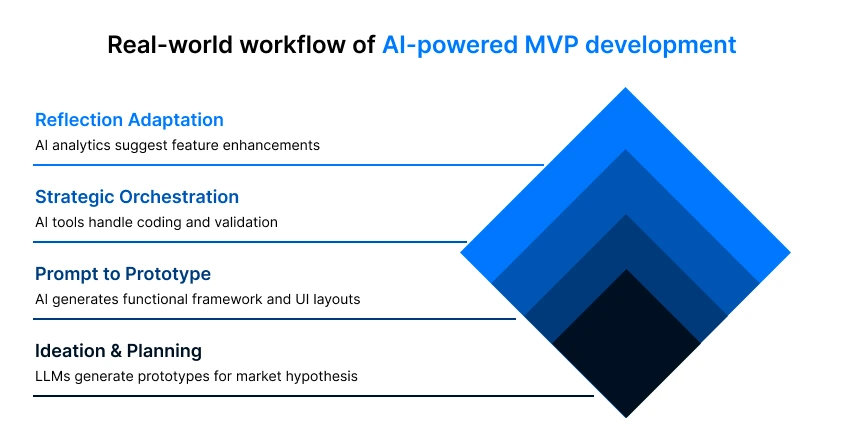
The real-world workflow of an AI-powered MVP generally follows a four-stage evolutionary integration (which we will also discuss in detail in the later section):
- Ideation and planning: Founders use LLMs like ChatGPT for exploratory building, which means generating multiple parallel prototypes to test divergent market hypotheses parallelly.
- Prompt to prototype: The founder describes the core problem and target audience with the use of AI to generate a functional framework and initial UI layouts in a matter of days.
- Strategic Orchestration: The AI tool stack is connected directly into the development workflow, with tools like Co-pilot handling the coding and KaneAI further handling the constant validation.
- Reflective Adaptation: The team enters a tight build-measure-learn loop where AI-driven analytics track user behaviors and suggest key feature enhancements on the basis of the real-time engagement data.
This workflow shifts the founder's most valuable asset from their network of developers to their ability to craft the perfect prompt. However, this speed brings the prototype paradox which is high fidelity prototypes that can sometimes outpace the team's ability to perform a real market validation thus also requiring founders to balance quick AI outputs with disciplined human oversight.
In this environment, successful start-ups are those that treat AI as a creative partner instead of just a utility so that human judgment remains in command of the automated engine.
Chapter 4: MVP vs. full app development
The strategic choice between creating an MVP and a full-scale app depends on understanding the difference between validating learning and monolithic risk. This chapter contrasts these two approaches across functional, financial, and temporal dimensions.
Key differences (features, cost, speed)
The fundamental difference stays in the intent of development. A full-scale product is the complete, final version containing all intended features and specifications ready for mass production and widespread use. In comparison, an MVP is a "bare bones" version that applies the underlying technology and core value proposition with the minimum set of features that are required to satisfy early adopters.
| Difference Basis | Difference Explanation |
|---|---|
| Features | MVP focuses on "must-have" features to solve a primary problem, while full products include "nice-to-have" features and polished user interfaces. |
| UI/UX Design | Midjourney, DALL-E, and Canva. Have become |
| Cost | MVPs are budget-friendly tools for resource optimization, whereas full products require a given capital investment upfront. |
| Speed | MVPs are built for continuous changes so that a business can move from concept to launch smoothly within in a fraction of the time required for a full app |
When to build an MVP vs. a full product?
Founders should start development with an MVP when there is market uncertainty or limited resources. The MVP serves as an exploratory early version used to test fundamental business hypotheses using scientifically validated experiments.
For developing a full product, it is only advisable after you achieve product-market fit, when user feedback has confirmed the demand for the solution and the business model has been de-risked.
Building a fully featured product without proper early validation is a primary driver of the 90% failure seen in early-stage startups.
Risk comparison
The risk profile of full app development is notably higher due to the "prototype paradox," which is the danger of spending months in building a polished version that the market does not actually want.
- Full app risk: High risk of large-scale failure, budget overruns, which affects 66% of projects and the accumulation of technical debt before the product's value is even proven.
- MVP risk: mvp development solutions focuses on risk stratification and mitigation. While an MVP may face risks like biased user feedback or an underdeveloped initial image, it gives strategic benefits without wasting extensive resources.
Cost comparison
There is a strong difference in the financial requirements for each stage.
- MVP costs: A simple landing page MVP may cost a few hundred dollars when you work with mvp product development agency, while advanced MVPs with working features generally range from $10,000 to $50,000.
- Full app costs: A full working app can range from $95,000 to hundreds of thousands as per the complexity. Furthermore, the total cost of ownership for a full product consists of heavy long-term maintenance, security updates, and infrastructure scaling, which mostly exceeds initial development costs.
Time-to-market comparison
Speed is an important competitive benefit in the digital economy.
- MVP timeline: It uses modern frameworks like Next.js and Supabase; an MVP can be shipped in 2 to 8 weeks, which allows startups to gain a first mover benefit and begin collecting data almost immediately.
- Full app timeline: Traditional monolithic development models generally take several months to years to complete. This slow entry risks obsolescence as competitors may find product market fit or market trends may shift before the "perfect" product is ever released.
Overall, the MVP approach is a strategic necessity that converts technology development from a high-stakes gamble into an agile, iterative process of de-risking.
Chapter 5: Step-by-Step MVP Development Process
The development of a minimum viable product is a systematic, multi-stage journey that focuses on validated learning over detailed feature sets. With a structured pipeline, founders can handle the risk of building products that the market does not want, which remains a primary driver for all the failure rates among startups.
Idea Validation (Market demand check)
The process does not start with brainstorming of features but with a deep understanding of a core problem. A given problem statement is important and in place of a generic goal like "helping people find food," a successful MVP targets "helping busy professionals quickly find healthy lunch options near their office."
To validate the demand, founders must move beyond just internal assumptions and engage with real people using user interviews (generally with 5 to 8 participants), surveys, and competitive analysis. A number of low-cost validation techniques are used at this stage no matter if you are going for wellness app development services or taking MVP services for any other industry.
- Smoke testing: Launch of a landing page with a "buy now" or "sign up" call to action to measure interest before any code is written.
- Concierge MVP: Giving the core service manually to understand the user journey and pain points intimately.
- Wizards of Oz MVP: Presenting a functional-looking interface while the underlying logic is handled manually behind the scenes, such as Zappos' early model of taking photos of shoes from local stores to test online sales without holding inventory.
Feature Focus (must have ones vs. nice to have features)
A common failure in product development is "overscoring," where teams attempt to deliver an exceptionally well product before validating their core hypothesis which is why ruthless focus comes very handy here to make the right feature list. The value breakdown structure assists managers in finding the minimum set of attributes that maximize value for early adopters while lowering the expenditure.
Features must be evaluated against three given criteria:
- Does it solve the primary problem?
- Can the product function without it?
- Will it help test the main business assumption?
The governing rule is to remove any feature or effort that does not contribute directly to the learning you seek, which most of the time comes out as a single feature MVP that tries to solve a problem with that one thing.
The process of Wireframing and preparing the UI/UX Design
When it comes to the phase for an MVP a business should always go for a minimal approach with flexibility of iteration because the goal here is to create a usable and reliable user-centric design that drives core interaction and feedback.
- Wireframing: This serves as the blueprint of the interface where a business defines the layout and structure of their MVP but without the distraction of colors or fonts.
- User Journey Connection: Here the imagination of the flow takes place to understand or see engagement opportunities and remove any kind of friction.
- Mobile first approach: As most users now use mobile apps, designing your MVP for the smallest screen will help you focus on understanding design patterns better than going for the easiest screens.
- Important Screens: A good MVP wireframe contains core screens that are landing page, signup, and dashboard and support screens like onboarding, settings, and error pages.
Backend and API planning
While the UI is minimal, an MVP must implement underlying technology and should always have a backend to be truly functional.
- Architectural choice: For early-stage speed, a monolithic architecture is always the preferred one in place of microservices because it simplifies the initial development and integration.
- API first design: This kind of approach lets other systems make use of the functionalities even before the final version of the software is completed and it is always easy to scale in future.
- Separation of Concerns: There are patterns like Model View Presenter, with which you can make sure that business logic and data management are separated from the UI so that the system is easy to test and maintain.
Development using AI tools
The irruption of generative AI has changed development into an act of strategic orchestration. Modern founders use AI tools as Silicon Valley interns that are very enthusiastic but require strong human supervision to avoid technical debt and security risks.
- Prompt to Prototype: Tools like GitHub Copilot, ChatGPT, and Claude boost coding with the generation of boilerplate, the explanation of complex algorithms, and the use of libraries.
- UI Automation: For this there are convolutional Neural Networks (CNNs) that are mostly used to translate graphical UI mockups directly into functional code frameworks to save time.
- LCNC Platforms: There are low-code or no-code tools like Bubble, Adalo, or FlutterFlow that let non-technical founders build clickable prototypes and internal dashboards not in weeks but within just days.
Testing and QA Automation
Validation for an MVP is different from traditional QA because it is more about constant learning and actionable insights in place of zero-bug software.
- Focus: The testing phase shall aim to monitor key user flows like signups, payments, API endpoints, and basic error handling.
- Test rich development: Writing test cases before developing functionalities with tools like Jest for React Native helps businesses to make sure that each component meets requirements and remains stable.
- Performance focus system: Above everything, teams must make sure that the product stays functional, usable, and optimized no matter in what phase it stays.
- AI in QA: Autonomous testing agents like KaneAI allow teams to create and evolve end-to-end tests using natural language to lower the manual review time even if you build healthcare app or another critical app.
Launch and iteration strategy
A product launch is not a single deploy button but an ongoing process of introducing value to a target audience.
Launch approaches
- Soft launch: The release of a small, niche group to collect initial feedback on usability and bugs without the risk of a full public release.
- Beta access: The release of a nearly complete product that stays under the validation by not releasing to a large group but to a smaller and controlled group.
Build, measure, learn loop
Post-launch, the focus shifts to the collection of data and metrics from user interactions. This feedback is used to confirm or refute business hypotheses and decide whether to preserve, and refine the overall business model and products or services.
Data-driven decision making
Successful MVPs track given KPIs like task success rate, Net Promoter Score, and retention rates to understand if the product is ready for scaling.
In a nutshell, the MVP process can be seen as a cyclic feedback loop that is built to make sure that the resources are spent only on features that users truly value, so that the start-up's journey is not merely a gamble but a scientific experiment.
Chapter 6: Timeline breakdown (traditional vs. AI MVP)
The most noticeable as well as measurable impact of the AI revolution in software engineering is the reduction of development cycles. What once took quarters now takes weeks, which gives an upper hand to businesses when it comes to "time to market."
Traditional Development Timelines
When we travel back to the pre-AI era, mobile app development was seen as a complex task that followed rigid software development lifecycles or what you may know as SDLC.
- The quarterly baseline: As per our experience, the traditional development suggests that a standard quarterly development cycle took an average of 14.2 weeks.
- Survey Data: On the professional level experience of our team, it is noted that it took 6 to 18 weeks to create a functional version of a native app.
- The hero dependency: If you look at the traditional timeline researches, there was a lack of standardized patterns and the reliance on a few key developers meant that if a single person left, it could add months to a project.
AI-powered development timelines
AI integration has given a spark and lift to the way products move from prompt to prototype.
- The 73% reduction: As per the empirical data, it can be confirmed that AI-augmented teams can deliver an MVP in just 3.8 weeks, which represents a 73% reduction in development time as compared to traditional expectations.
- Ship in a week: With specialized fast stacks like Next.js, Supabase, and Vercel, even the experienced developers can now deploy a basic full-stack MVP in under a week.
- Intensive Sprints:Success stories do highlight founders who build their first MVP over a single weekend, which is 48 hours, with AI who handle boilerplate code and UI layouts.
Phase-Wise Comparison
| Phase | Traditional Timeline | AI Powered Timeline | AI Impact |
|---|---|---|---|
| Discovery & Planning | 2-3 Weeks | 2-3 days | AI extracts tasks from user stories with 90% accuracy. |
| Design & UI/UX | 3–4 Weeks | 1 Week | CNNs automate the translation of mockups into code prototypes. |
| Development (Coding) | 8–12 Weeks | 2–3 Weeks | Developers finish coding tasks. 55.8% faster with AI pair programmers |
| QA & Testing | 2–3 Weeks | 3–5 Days | Autonomous agents (KaneAI) plan and author tests using natural language. |
Realistic Delivery Expectations
While AI creates a dizzying acceleration, founders must balance the speed with disciplined human oversight and a realistic expectation for a modern and high-quality MVP that stays between 4 and 8 weeks. It is because it allows for the following:
- Validated learning, where the product actually solves the core problem instead of just looking polished.
- Strategic adaptation because there is time to study user feedback within the build-measure-learn loop and make important changes.
Factors that affect the timeline
Multiple variables can still affect the delivery speed:
- Complexity Drivers: High-fidelity animations, complex custom algorithms, or bleeding-edge tech experimentations always add up to those extra timelines.
- Device Fragmentation: When you build for thousands of Android and multiple iOS variants, then it is surely going to add to more testing time.
- Third-party integrations: If you rely on external APIs for payments, maps, and other useful things, then it may (not necessarily) give you delays that are outside the team's control.
Chapter 7: Cost Breakdown of MVP Development
The toughest part of software engineering is accurate cost estimation because 66% of projects face cost overruns just because of unrealistic budget setting.
Traditional Cost Structure
Without any second thought, if you go for traditional monolithic models, then building a mobile app comes out as an expensive venture because the general estimates for the basic apps range between $40,000 and $100,000.
If you go for complex categories, then a simple digital brochure app is going to require 400 hours, while complex apps with real-time features and custom backends are going to require 1500+ hours in development, which can cost over $300,000.
But know that with the traditional model, you do waste resources due to a lack of market validation on overscoring that is building the features that users may never want to use.
AI-powered MVP cost model
The MVP approach changes notably when you make the shift in technology from a high-stack gamble to a faster, cost-efficient development model.
So here a landing page MVP used to validate demand can cost only a few hundred to a few thousand dollars. Then for the advanced MVPs, there are functional versions with must-have features that generally range from $10,000 to $50,000.
There are also zero cast starts, where many modern tools let you use the first 3 to 6 months free so that a startup can validate their idea with nearly $0 in infrastructure costs.
Cost-saving areas with the help of AI
You can save with AI in a number of phases, like:
- UI/UX: Because AI-powered design kits and stock UI components can save 10 to 15% of the total budget.
- Backlog management: With AI-based backlog grooming, one can lower the planning time by 2.3 hours per sprint.
- Backend efficiency: Systems like Supabase offer auto-generated APIs that remove the need for expensive DevOps overhead at the time of early stages.
Hidden Costs Founders Ignore
For the starting development cost, it is often only a small portion of the total cost of ownership but this may come out as a bigger hurdle if a business is very tight on the budget.
- Maintenance costs because when your app is successful, you have to spend 20% of the total development cost annually on fixing the bugs, updating the OS, and tuning for better performance.
- Infrastructure scaling because as the user grows, server and data storage costs increase nonlinearly.
- Quality Assurance because any ignorance on QA can result in poor reviews and user desertion, which is an indirect cost that can easily kill a startup.
Pricing Models- The Fixed, Hourly, Milestone-based cost models
| Model Name | Model Description |
|---|---|
| Hourly Rates | Vary drastically by region—from $20–30/hr in Southeast Asia to $100–160/hr in North America |
| Fixed Price | Best for small, well-defined MVPs where the scope is "set in stone." |
| Time and Materials (T&M) | This is very cost-effective for complex projects where the scope changes on the basis of the real time user feedback. |
| Milestone-Based | Removes risk by releasing payments only after specific deliverables for example after the complete validation of wireframes or a given beta version |
Chapter 8: Common App Types (with their time and cost estimates)
There is no one strategy that fits all when it comes to MVP because every industry introduces its unique challenges or complexities that a business has to handle properly. Here are some of the most important app types that your MVP and final app might be falling into.
Taxi Booking App (Like Uber)
A functional taxi booking app MVP focuses on three different interfaces: the passenger app, the driver app, and the admin panel. The key features may differ from app to app but still features like user/driver registration, GPS-based geolocation for real-time tracking, and matching algorithms to connect riders with nearby drivers remain the main core features.
Now for the development time, a dual-platform (for iOS and Android both) native taxi app requires 12 to 18 weeks but with AI assistance, the same can be reduced to 4 to 6 weeks. However, the cost to develop an Uber-like MVP can be a little costly due to the complexity which can be around $20,000, though geolocation-specific features can affect the budget further.
Food Delivery App (Like Zomato or Uber Eats)
This asks for a complex "tri-party" ecosystem which consists of the User Module for browsing and ordering, the Restaurant Module for order management, and the Delivery Module for route optimization. When it comes to on-demand delivery apps they fall under the most expensive categories because they require continuous backend sync at all times. If you go with a traditional build, it can usually take 15+ weeks, but AI-powered workflows aiming only the "must-have" features can help you launch in just 5 to 7 weeks. Now for the costing part, you can set your budget in the range of $50,000 to $120,000 for the full app development.
E-commerce App (Like Amazon)
The main focus for this MVP is a solid product catalog, search and filters, a shopping cart, and a secure checkout process. With the traditional timelines you can expect around 10 to 12 weeks but AI development can generate product schemas and UI layouts quickly to reduce that cycle to 3 to 4 weeks.
You can set aside around $40,000 to $100,000 in terms of budget for an Ecommerce app that is actually scalable.
Social Media App
The core functionality here consists of user profiles, activity feeds, content posting for images or text, and basic engagement like likes, comments, and sharing. A simple microblogging app which is similar to Twitter can be built as a single-feature MVP in about 4 to 6 weeks.
But if you go as complex as the other social media platforms like Snapchat, the price range moves between $45,000 and $100,000.
Real Estate App
A few important features for a real estate MVP consists of property listings, advanced search filters, high-quality image galleries, and contact forms so that buyers can connect buyers with agents directly.
The estimated cost stays between $30,000 and $60,000 but if you take help of AI for automated image tagging and listing descriptions then you can save up to 15% in content management time.
Logistics / Fleet Tracking App
These apps are very backend-intensive as they rely on real-time GPS tracking, route optimization, driver status dashboards, and proof of delivery via signatures or photos. A traditional build takes 12 weeks, but an AI build can cut it down to 5 weeks; however costs vary from $40,000 to $80,000 as per how many API integrations you need for maps and traffic data.
Education / EdTech App
If you want to create an MVP app like 360 learning which focuses on course delivery, user enrollment, video streaming, progress tracking, and quizzes or certificates, then you have to be prepared for some complexities again. The cost for this ranges from $60,000 to $120,000 but AI can play a big role here to notably speed up the creation of quizzes and transcripts directly from your video content.
Healthcare App
Due to strict security and compliance like HIPAA, healthcare apps are considered high-risk and high-cost. The MVP features include patient profiles, appointment scheduling, secure health records, and teleconsultation via video or chat. Because of the heavy security layers, the costs often exceed $80,000.
On-Demand Services App (Like Urban Company)
Similar to delivery apps, on demand apps require two separate interfaces for the customer and the professional. The MVP needs service provider listings, a booking calendar, scheduling logic, and in-app payments. You are looking at a cost range of $40,000 to $90,000 to get this off the ground.
Fintech / Wallet App
Financial platforms require the strongest foundations possible and in every MVP, you have to deliver features like secure authentication, payment processing, transaction history, and basic KYC. For the cost part, you can plan the investment of $20,000 for a simple finance/wallet app to $300,000+ if you are looking to build a complex banking system.
Chapter 9: Detailed Comparison Table (All App Types)
The following table further summarises the timeline, cost, and technical recommendations for launching an MVP across various sectors (mostly the ones we discussed in the previous section). For the costing parts, know that they reflect hire mobile app developers in India rates (20–30/hr) compared to Global/US rates (60–120/hr) because India has been one of the top most hubs when it comes to outsourcing IT engineering projects.
| App Type | Key MVP Features | Traditional Development Time (Wks) | AI Development Time (Wks) | Cost Range (India / Global) | Complexity | Recommended Tech Stack |
|---|---|---|---|---|---|---|
| Taxi Booking | GPS, Matching, Payments | 12–18 | 4–6 | $15k–30k / $40k–100k | High | React Native, Node.js, Google Maps API |
| Food Delivery | Order Tracking, 3-way App | 15–20 | 5–7 | $20k–45k / $50k–120k | High | Flutter, Supabase, PostgreSQL |
| E-commerce | Catalog, Cart, Payment | 10–12 | 3–4 | $12k–35k / $40k–100k | Moderate | Next.js, Stripe, Tailwind CSS |
| Social Media | Feed, Profiles, Chat | 8–14 | 3–5 | $10k–30k / $35k–80k | Moderate | React, Socket.io, AWS S3 |
| Real Estate | Listings, Search, Maps | 8–10 | 3–4 | $8k–25k / $30k–60k | Moderate | Next.js, Supabase, Algolia Search |
| Logistics | Fleet Dashboard, GPS | 10–14 | 4–6 | $15k–35k / $40k–90k | High | React Native, Python (AI optimization) |
| EdTech | Videos, Progress, Quizzes | 10–12 | 4–5 | $12k–40k / $60k–120k | Moderate | React, Node.js, Mux (Video) |
| Healthcare | Records, Booking, Video | 14–18 | 6–8 | $25k–60k / $80k–150k | Very High | React Native, AWS (HIPAA compliant) |
| On-Demand | Scheduling, Profiles | 12–16 | 5–6 | $15k–35k / $40k–90k | High | Flutter, Node.js, Firebase |
| Fintech | KYC, Payments, Auth | 16–22 | 7–10 | $20k–80k / $50k–250k | Very High | React, Go (Security), PostgreSQL |
A few Key Takeaways
- AI can easily reduce up to 73% of the development time especially if you do not need deep personal touches.
- Security, compliance and real time functionality remains one of the most complex variables
- High infrastructure apps like social and on demand must plan for nonlinear scaling costs right from day one.
- Going with a mobile application development company in India will be the most feasible option due to low living cost but exceptional talent in engineering.
Chapter 10: Tech Stack for Fast MVP Development
The choice of the right technology stack is not just a technical decision but more of a hiring and velocity decision that determines how quickly a founder can ship a product to market. And, in 2025 to 2026, the shift is completely visible, where we are not just building complex infrastructure but making better use of high abstraction tools that allow rapid iterations.
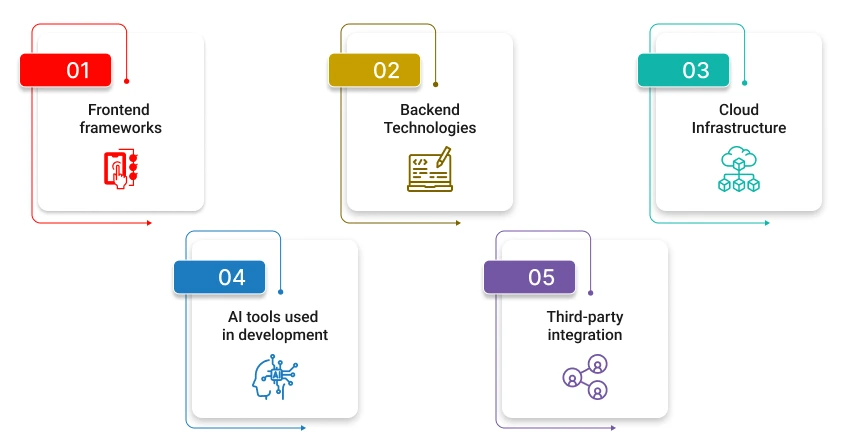
Frontend frameworks
React remains the main choice just because of its massive ecosystem and component-based architecture, which lets developers reuse the code at a number of places. But, for MVPs, Next.js is one of the most influential standards in the industry because it connects server-side rendering, SEO optimization, and built-in API routes into a single framework.
Further, vite is constantly replacing the older build tools because it makes the development of the server as much as 10x faster, which removes the burden of a very complex task from developers.
Backend Technologies
For the backend technologies, Node.js with Express is the most popular choice when it comes to startups because it lets developers use JavaScript across the entire stack, thus removing the context switching. Further, Supabase has come out as the reliable wingman for MVPs, which gives you a production-ready PostgreSQL database with built-in authentication, real-time subscriptions, and auto-generated APIs out of the box.
If extreme performance for real-time applications or microservices is required, there is Go (Golang), which is recommended for its concurrency support.
Cloud infrastructure
The modern cloud based mobile apps strategy focuses on zero-ops deployment platforms where Vercel and Netlify are a few preferred choices for the frontend and Next.js is used for hosting so that "deploy with one command" workflows can be achieved.
For full-stack mobile apps for cloud computing, Railway or Render delivers a simple alternative to the complexity of AWS or Google Cloud for the early stages, and start-ups should also utilize cloud-native services to lower the infrastructure management and focus on features.
AI tools used in development
AI engineering and integration has changed coding from a manual task to a strategic orchestration role (the concept we have been talking about a lot of times in this guide). But for a brief again, GitHub Copilot and Claude Code act as "AI pair programmers" that generate boilerplate code and explain complex logic, which helps developers finish tasks 55.8% faster.
For autonomous execution, there is Devin AI, which is used as an individual developer who can handle entire features from planning to implementation.
Third-party integrations (payments, maps, and chat)
For the maintenance of speed, MVPs must "use existing technologies" instead of reinventing the wheel if they really want to save the budget. There is Stripe, which is a universal choice for payments and supports everything right from one-time purchases to complex subscriptions or EMI payment models.
Then there is Google Maps API, which is the gold standard for geolocation apps like taxi or delivery services. In case a business needs real-time communication, they can make use of Socket.io or Pusher, which are used to implement chat features with minimal complexities.
Chapter 11: UI/UX Strategy for MVP Success
The success of your MVP really depends on the UI/UX design because this is the first thing that your users will see and interact with.
Why go for a simple UI?
Till now you must know that MVP aims to provide the simplest version of a solution and the same goes in terms of design, where your interface should reflect one primary use case exceptionally well. The goal is not to build a rough draft but a very functional version that provides validated learning while also remaining lean.
Design for speed as well as usability
The design process starts with user research, where one shall perform 5 to 8 user interviews to create detailed user personas like "Sarah, the busy entrepreneur" to make sure that the MVP aligns with real-world behaviours. Your designers will prepare wireframes that work as a blueprint to prepare layout and structure without the distraction of aesthetics.
A mobile-first approach is another crucial element here because it will force your design team to focus on key content components for the smaller screens right from the start.
A few common UI mistakes to avoid
- Avoid the feature bloat as much as possible because the goal is to test the viability of your product idea.
- Do not overcomplicate the interface with unnecessary features that distract the users from the core value your solution offers.
- Do not design for desktop aftermath because it is a parallel process.
- Never ignore loading states and error handling.
- Avoid skipping user testing just because you are running short on time.
AI tools for UI design
There are several AI tools that you can use for your UI design to further compress the product delivery timeframe. Some tools like Midjourney and DALLE are used for constant visual exploration and asset generation, followed by convolutional neural networks, which can now automate the translation of graphical UI mockups directly into functional code prototypes, which also speeds up the design to development handoff.
Chapter 12: Testing and Quality Assurance of MVP with AI
Do not confuse the process of QA with what it used to be because it is no longer a complete manual process but more of an automated one led by AI for speed and reliability.
Traditional Testing vs. AI Testing
We have talked a lot about AI and the same applies here because traditional testing was 100% human-driven and often raised delays during the major updates. In comparison, autonomous testing makes use of AI to create, run, and analyze tests on its own without or with minimal human intervention.
Automated Testing Tools
There are tools that allow teams to author and evolve end-to-end tests with the help of natural language prompts and a couple of them are
- Katalon
- TestMu AI (KaneAI)
These tools can generate test datasets that simulate diverse user behavior and edge cases in just a matter of seconds, which might not be possible for a human mind to memorize.
Reduction of Bugs with AI
AI systems have reached a point where they provide predictive defect analysis to identify high-risk areas of the code that are most likely to fail based on the historical data. The self-healing test scripts automatically detect changes in the UI and fix broken element locators, thus reducing the manual maintenance time by up to 40%.
Performance optimization
Startups should also follow the performance priority pyramid, which is about making it work, then making it usable, and then making it fast and only making it scalable when the user base justifies it. There are AI-driven monitoring tools for the same, like Sentry and Mixpanel, that are used to track real-time performance and user behavior.
Chapter 13: Launch Strategy for MVP
A launch is not a single event but more of a series of strategic processes that introduces a product to the target audience to gather the feedback and iterate.
Soft Launch vs Full Launch
- Soft Launch: With this type of launch, you release your MVP to a small, niche group for testing the waters and collect the feedback on usability and bugs without the risk of failure in public.
- Hard Launch: This is a nearly full-scale marketing push used by big companies or validated start-ups to reach a wider audience quickly, though should not be confused with a full product launch yet.
- Dark Launch: Releasing new features quietly to a tiny percentage (around 1%) of users to observe their behaviour in real time.
App Store and Play Store Guidelines
App stores act as vetted marketplaces that follow a strict screening process for security and compatibility. The developers must use over-the-air (OTA) updates using tools like Expo to fix small errors without going through the lengthy app store review process for every change. These guidelines vary for the Play Store and app store so there is no one-size-fits-all scenario but if you aim to design for users, then most probably your product is going to register the desired success.
Google Play Store Guidelines
- You must have an active Google play developer account and have paid a one-time $25 registration fee. For corporations further legal documents are required as asked by Google.
- Child endangerment, Inappropriate content, financial services not complying with laws, real money gambling, Illegal activities, user generated content are few of the app types that are completely restricted from Google play store.
- Requires clearly labelled AI generated content in case your app relies on AI generated content.
- Apps cannot hold any intellectual property like copyright material, trademarks or patented technologies.
- Improper handling of data is not allowed in the apps hence every app must implement authentication and access controls.
- Apps must make permission requests if they want to make use of any device features or want to use internal APIs.
- Misrepresentation or fraud apps are completely prohibited on the google play store.
- Any kind of malware or device abuse will result in permanent account ban on google play store.
- The app must clearly show what is their monetization model and if they will have ads in their app or not.
Apple App store Guidelines
- You have to first enrol in the Apple developer program and pay the annual fee of $99.
- Apple pays strong focus on design and user experiences so you have to follow human interface guidelines for consistent and intuitive user experience.
- Optimized for the latest iOS version and devices
- Performance and functionality should be smooth with best security and stability surety.
- Content and age ratings are there so that there is no sensitive or fraud materials.
- A clear privacy policy and data collection process is to be shared with the user.
- Apps must show what all purchases or payments they are going to charge from the users.
Early user acquisition
- You have to first enrol in the Apple developer program and pay the annual fee of $99.
- Apple pays strong focus on design and user experiences so you have to follow human interface guidelines for consistent and intuitive user experience.
- Optimized for the latest iOS version and devices
- Performance and functionality should be smooth with best security and stability surety.
- Content and age ratings are there so that there is no sensitive or fraud materials.
- A clear privacy policy and data collection process is to be shared with the user.
- Apps must show what all purchases or payments they are going to charge from the users.
Early user acquisition
Successful starts make use of interactive storytelling and build in public strategies to build anticipation. They launch on niche platforms like Product Hunt, Reddit, or special AI directories like Futurepedia that help them validate their unique value propositions while also collecting the actionable insights.
Chapter 14: Post-launch growth strategy
As soon as the MVP is live, the focus changes to the build-measure-learn loop in order to achieve product market fit.
Iteration based on user feedback
Founders must collect data from user interactions and use it to refine the product with constant iterations. There are tools like Mixpanel and Hotjar that are important for tracking clicks and finding features that are not being used as expected by the business.
Feature scaling roadmap
Scaling stays a constant process where the startup slowly shifts from a basic version to a full-fledged product. Here the business scale resources slowly move from a single server to horizontal scaling with database replicas and load balancing but it takes place only when the demand rises to save the costs.
Monetization strategies
MVPs are also used to understand the willingness to pay from users. A few common digital monetization strategies involve
- Freemium
- Subscription models
- Advertising
- Transaction fees
This timeline framework reflects how AI programs operate in real production environments.
Retention and Engagement
When we talk about success metrics there are a few ones like the task success rate, net promoter score, and retention rate. You can gamify the experience slowly with points, badges, or progress bars that can help keep users hooked and reduce the churn rate.
Chapter 15: Case Studies / Examples of Successful MVPs and Why Choose AI-Based MVP Development?
Startup MVP Success Stories
- Airbnb: It started as a simple one page website where they rent air mattresses at the time of a conference which helped them to test the basic functionality of their final booking accommodation idea.
- Dropbox: Built a simple explainer video to validate interest in file syncing, then gained 75,000 signups in one night before even a single line of code was written.
- Zappos: Validated the online shoe market where it took photos at local stores and shipped them manually to test demand without holding any inventory.
How Fast MVP Helped Reduce Risk?
Let us quickly understand this with an example of the Lemonade insurance startup, which bootstrapped an initial AI prototype using open-source libraries and then scaled only after validating the concept. Similarly, Food on the Table used a "Concierge MVP" to manually select recipes for users, finding out the weaknesses in the concept through direct interaction.
Both these products reduced the risk of launching a failed product to nearly zero and scaled only when they found out that their idea was going to sell well.
Before vs. After AI Adoption
Although we have talked about this in our previous section in detail, traditional quarterly development cycles nearly averaged 14.2 weeks. With AI-augmented workflows, teams now deliver the same MVP versions in just 3.8 weeks, which shows that there is a 73% reduction in time-to-market.
Why Choose AI-Based MVP Development?
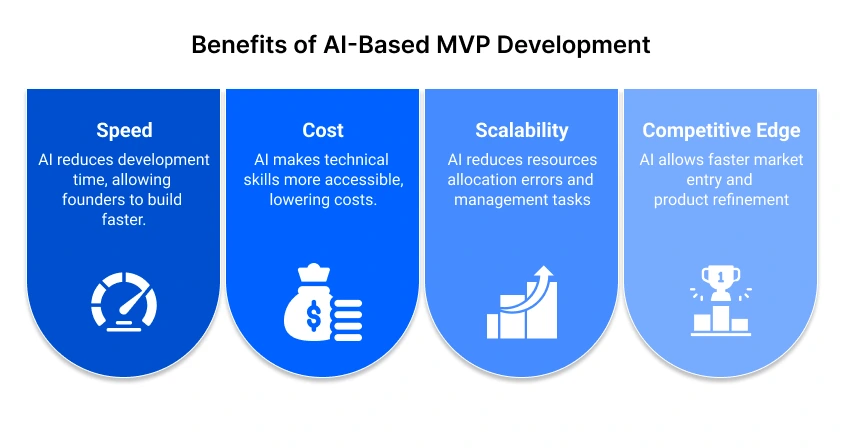
The speed benefit
With AI assistance, development reduces the distance between idea and implementation, which allows founders to build in a weekend what used to take months. Just for a reference, developers who use AI assistants work 55% faster on average.
The benefit of cost
The AI integration helps founders convert the previously rare and expensive resource of high-level technical skill into an accessible and non-dense one. This leads to a notable decline in operational expenditure and initial development costs.
Scalability
AI-powered cloud management reduces resource allocation errors by 30% and routine management tasks by up to 40% so that start-ups can scale without a linear increase in human technicians.
Competitive Edge
In a market where speed and innovation win, AI allows start-ups to enter the market faster and refine their products or services on the basis of real-time usage data to make sure that they stay ahead in the competition.
Chapter 16: Why Choose NetSet Software for Your MVP?
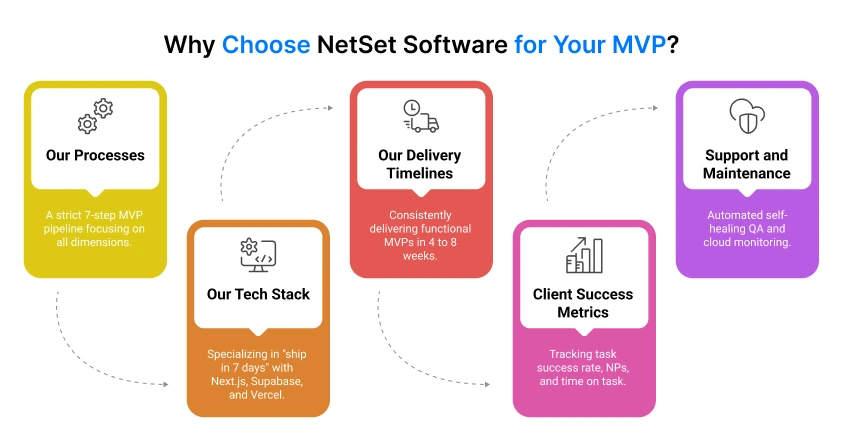
Our processes
We practice a strict 7-step MVP pipeline where we focus on all the dimensions of an MVP right from idea validation, user research, ruthless prioritization, wireframing, AI-driven development, autonomous QA, and the build-measure-learn-launch cycle [Road Artifact].
Our Tech Stack
We specialize in the "ship in 7 days" with the stack: Next.js (front end), Supabase (backend/database), and Vercel (infrastructure) combined with AI tools like GitHub Copilot and Devin.
Our delivery timelines
While traditional agencies take 14 weeks, our AI-powered development approach consistently delivers functional MVPs in 4 to 8 weeks, which allows you to connect data from real users almost immediately.
Client Success Metrics
We do not just ship code; we track task success rate, NPs, and time on task to make sure your MVP achieves product-market fit.
Support and Maintenance
We provide automated self-healing QA and cloud monitoring to handle platform updates and bug fixes, which generally cost around 20% of initial development annually.
Chapter 17: Quick Recap checklist for Founders
- Validate Idea: Conduct 5-8 user interviews and create a primary persona
- Define MVP Scope: Use the Value Breakdown Structure (VBS) to remove all "nice-to-have" features and only focus on core ones.
- Choose Development Partner: Select a team like NetSet Software who has strong experience in MVP technologies like Next.js, Supabase, and AI-assisted workflows
- Plan Budget: Factor in the Total Cost of Ownership (TCO), including annual maintenance so that you put your funds into what’s necessary
- Launch Fast: Aim to ship a functional version in under 8 weeks to start the Build-Measure-Learn loop.
Frequently Asked Questions (FAQs)
1. How much does it cost to build an MVP in 2026?
If you go for a simple MVP then it is not going to cost you that much but for a few working features, you can expect around $10,000 to $50,000 in investment.
2. How long does MVP development take?
With AI assisted development an MVP can take anywhere from a few weeks to nearly a month or two however the average for high quality multiple feature MVP version may take around 4 to 8 weeks.
3. Can AI really build apps faster?
Yes, as per the MVP development experience of NetSet Software, AI can reduce the development cycle by up to 70%.
4. What is the cheapest way to build an app?
The most cost efficient way to MVP approach is using the low code or no code tools but that too requires collaboration with an experienced partner who can turn your MVP idea into a real product.
5. MVP vs full app- which is the better option to go with?
An MVP is always better for the early stages instead of a full app because you get to test the viability of your idea and lower the risks that come with full product development.
6. Which app idea is best to start with?
The best idea is one that solves a real problem for the users helping busy professionals find healthy lunch options and starts with the validation process using MVP development.