1. What is AI Consulting?
AI consulting is the process of helping businesses use artificial intelligence to solve specific business problems. It combines basic technical understanding with knowledge of how a business operates, so AI is applied in a way that supports real goals. When you are using AI consulting in small businesses, the only focus is on how AI is working in the business and adding value, not on where it looks good.
At first, AI starts looking through the functions of the company, and what their future achievements are, and what they already have in the form of data. Based on this, AI approaches are planned and adjusted to fit the business needs. The purpose of AI consulting is to make sure artificial intelligence works for the business requirement, not the other way around.
2. Key Roles of An AI Consultant
The role of an AI consultant is significant in leading the process of artificial intelligence within an organization, from the initial process of decision-making to the later stages of management. This position is not restricted to technology decisions. It is concerned with how AI applications can be aligned with the business needs, operational facts, and quantifiable results. This position gains even more importance in the context of AI consulting in small businesses, where each decision should be accurate, cost-efficient, and long-lasting.
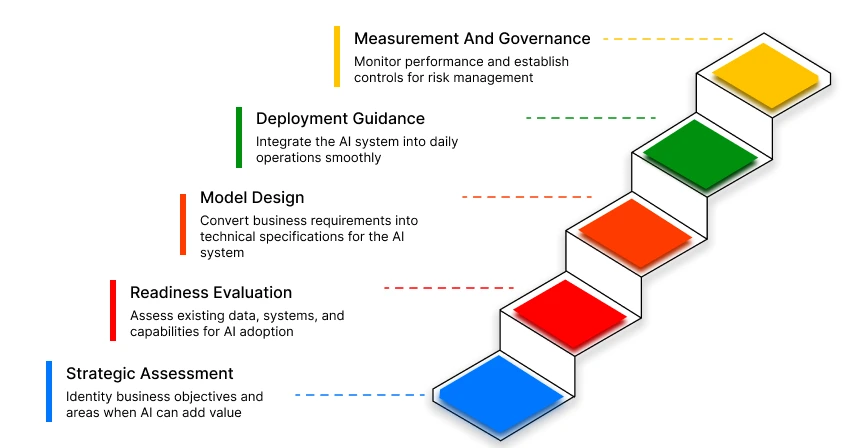
An AI consultant typically works across five key areas. Each area builds on the previous one to ensure AI is introduced in a structured and controlled way, rather than based on assumptions.
2.1. Strategic assessment
The strategic evaluation identifies the reasons why AI should be taken into consideration. The consultant studies the business objectives, operational challenges, and decision-making processes to determine areas where artificial intelligence can contribute value to the business organization. This step helps to prevent the adoption of artificial intelligence where it is not needed.
2.2. Readiness evaluation
Readiness assessment is used to find out how well the organization is set up to assist AI utilization. This involves the review of existing data, system maturity, and internal capabilities. The gaps are identified early to avoid problems later in development.
2.3. Model design
The business requirements are converted into technical direction during model design. It specifies what the system should do, what data it should use, and how it should be measured for performance. It is less concerned with complexity and more concerned with practicality, stability, and consistency with real-world workflow.
2.4. Deployment guidance
Deployment guidance includes the introduction of the AI system into the daily operation. This involves integration planning, rollout sequencing, and usage alignment. The aim is to make the system functional in actual conditions and not interfere with the current processes.
2.5. Measurement and governance
Measurement and governance give accountability. Performance is monitored against specified objectives, and controls are established to handle risk, dependability, as well as relevance and sustainability. This ensures that AI systems remain business-oriented as the conditions evolve.
3. What is the Importance of AI Consulting in Your Small Business?
Now, every small business is including AI in the conduct of their operations and competitions. Nonetheless, implementing AI without a systematized approach tends to create systems that are not in line with business operations or that provide uniform results. The role of AI consulting is significant because it allows business owners to understand the areas where AI can or should be used, as well as the outcomes that should be anticipated prior to any technical task.
Statistics show that adoption does not always lead to results. Netguru estimates that 78 percent of businesses apply AI to at least one business function, but many fail to prove how the application of AI translates into improved performance.
This disconnect is because AI projects often come with ambiguous goals, a lack of success indicators, and knowledge of their operational effects. AI consulting resolves this by offering guidance at the level of decision, where risks are minimal, and power is maximum.
In the case of a small business, execution risk has more consequences. Small budgets, small teams, and operational constraints imply that errors are more difficult to sustain. Consulting helps in mitigating this risk as it evaluates the state of data, determines the appropriate use cases, and other constraints before development or deployment. This will enhance coordination of technology choices and business requirements.
Manual-solutions fails in the case of AI projects. The more systems enter customer interaction, internal workflow, or prediction, the more complex the planning becomes. AI consulting offers transparency, consistency, and responsibility in these decisions.
AI consulting is particularly necessary when:
- AI initiatives affect revenue, quality of services, or output.
- Various Teams deal with AI-driven systems.
- Business executives need predictability and control.
Through proper guidance, AI can be a regulated business endeavor, which can aid in stability, scalability, and informed decision-making in the short term.
If the use of AI in your organization has an effect on your core workflow, the experience of customers, or on efficiency, lack of precision around implementation can be costly. NetSet Software Solutions helps smaller and medium organizations establish AI projects whose success is measured before writing any code
This includes identifying high-impact use cases, validating data readiness, and setting clear success metrics so investments translate into real business performance rather than experimental effort.
4. Practical Applications of AI in Small Business Operations
Artificial intelligence is useful in the context of small businesses as long as the AI is used in particular areas of operation with definite results. Instead of being a general transformation layer, AI is most effectively implemented inside existing processes to enhance the accuracy, speed, and predictability. The applications below are the most realistic and popular applications of AI in small business operations today.
4.1. Predictive analytics for demand forecasting
Predictive analytics is used to forecast the future demand based on the past data, the seasonal trends, and external factors. In small business this comes in particularly handy when planning inventory, manpower planning, and cash flow planning.
The AI models are able to detect changes in demand sooner than the manual process, and businesses can adjust the procurement or production before it becomes a problem. This minimises inventory shortages, surplus inventory, and reactive decisions.
4.2. Workflow automation
Workflow automation uses AI when dealing with repetitive and rule-based operations. Examples are processing of the invoices, document classification, internal approvals, and scheduling.
Making them automated drives businesses to save on processing time and the need for human intervention. The outcome is a higher level of operational consistency and a more efficient distribution of the employee effort on higher-value work as opposed to administrative work.
4.3. Customer support with NLP
NLP delivers AI to read and respond to customer queries using chat, email, and messaging services. Regarding the small business, AI-based support will be able to address frequent questions, order questions, and basic troubleshooting.
This enhances fast responsiveness and service accessibility, as well as enabling human teams to handle the complicated or delicate engagements. In the long run, NLP systems also give an insight into the common customer problems and gaps in the services.
4.4. Marketing personalization
AI-driven personalization will examine the kind of behavior, preferences, and engagement of the customers to personalize the marketing messages. This is used by small companies to divide the types of audiences, optimize the timing of campaigns, and change content relevance on channels.
Rather than mass communication, AI helps to deliver targeted messages, which enhance the rate of engagement and minimise the marketing wastage. This application is specifically effective when integrated with the already existing CRM and analytics systems.
4.5. Operational optimization
Operation optimization involves AI to enhance performance in interrelating business processes. This comprises route planning, pricing, allocation of resources, and performance.
AI finds inefficiencies that are hard to spot by hand and suggests some adjustments because of actual operating conditions. In the case of a small business, this translates to their operations being more predictable, and the utilization of limited resources is enhanced.
According to Fullview, adoption of AI can boost productivity by 26 to 55 percent. The highest level of gains can be seen when AI is utilized in determining definite processes and not broad initiatives.
In these applications, the factor of focus is the similarity. AI provides returns as long as it is used purposefully, embedded in the business, and quantified against a business deliverable instead of the hypothetical capability.
5. Industries That Benefit Most From AI Implementation
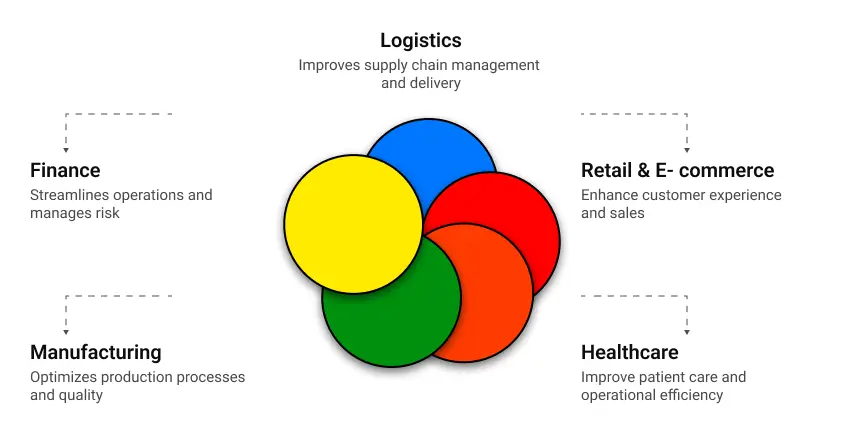
AI generates the most value in those industries where decision-making is frequent, the data is constantly produced, and efficiency has a direct impact on margins. Although AI can be utilised in any industry, some industries have had more returns due to the fact that their activities are highly compatible with data-driven systems and automation. The following is an analysis of sectors of the highest and most consistent impact of AI implementation.
5.1. Retail & E-commerce
The use of AI in the retail and e-commerce industries drives the use of demand forecasting, price optimization, inventory management, and customer behavior. The use of these AI systems enables the company to gain insights into customer buying behaviors and inventory management. This minimizes inconsistency in the inventory and produces the turnover of the items.
5.2. Healthcare
Diagnostic assistance, patient data analysis, optimization of schedule, and operational efficiency are some of the areas in healthcare where AI helps. The patterns of medical information, better allocation of resources, and also less workload of the administration are identified with the help of AI models. The value is in better accuracy and consistency, as well as helping healthcare professionals in decision-making, as opposed to substituting them.
5.3. Manufacturing
The manufacturing process is dependent on the stability of the processes and the predictive vision, and thus, it is one of the industries where AI can be successfully implemented. Its use is common in predictive maintenance, quality inspection, demand planning, and production optimization. AI is used to detect inefficiency at an early stage, minimise downtime, and enhance output consistency between production cycles.
5.4. Finance (BFSI)
Application of AI in the finance industry includes risk analysis, fraud analysis, customer analysis, and automation of processes. AI systems work with transactional data in high volumes and identify anomalies and evaluate credit risk, as well as assist in compliance needs. With these applications, accuracy and speed are increased, and operational overhead is minimized in highly regulated environments.
5.5. Logistics
AI is useful in logistics operations, in terms of route optimization, demand prediction, warehouse management, and delivery scheduling. AI is used to enhance the visibility throughout the supply chains and improve the coordination between inventory, transportation, and fulfilment. This results in less lost time, better use of assets, and predictable operations.
In these sectors, AI brings value to the extent that it is used on well-defined processes that have a quantifiable result.
Zipdo industry analysis indicates that the average return on investment in organizations that have been using AI consulting is around 245 percent, which indicates the effect of well-structured adoption of AI.
Industries that are most beneficial to AI have these characteristics in common, namely, the data-rich environment, repeatable processes, and heavy decision-making operations. With such prerequisites in place, AI deployment is more of a feasible means of bettering performance than a far-fetched investment.
6. The Expertise Gap and Consulting Advantage
With the growth in artificial intelligence usage, most organizations are falling increasingly behind in terms of ambition and implementation. The skills needed in AI initiatives are not easily available in internal teams, even in small and mid-sized business organizations.
Gaps in data science are typically core gaps, as model logic and data preparation are misinterpreted in MLOPs, where systems need to be deployed, monitored, and maintained, and in governance, where accountability, risk control, and performance oversight are needed.
The work of AI is not typically easily incorporated into the existing roles, which is why internal teams tend to struggle. Data-driven models can be unfamiliar to the developers, and business units can be reluctant to know the technical limitations underlying AI systems.
The operational complexity of managing data pipelines, tracking the behavior of their models, and providing updates over time is something most teams are not designed to manage. Consequently, AI projects stagnate, fail, or continue their work in isolated applications.
This is a well-known challenge. Zipdo industry data shows that 73 percent of organizations point to the shortage of internal AI expertise as a significant barrier to adoption. It is not the issue of access to tools but the ability to apply and utilize them appropriately and regularly.
AI consulting bridges this implementation gap by offering specialized skills, strategy, implementation, and supervision. NetSet Software Solutions, as a consultant, has experience with numerous deployments and therefore assists organizations in avoiding major pitfalls and also makes technical decisions that are in line with business priorities.
More to the point, the concept of consulting brings order. It outlines roles and responsibilities, sets working standards, and provides stability of AI systems after implementation. Consulting has the benefit of speed and control. With additional expertise to internal teams, organizations will be able to proceed with clarity, minimize operational risks, and implement artificial intelligence confidently instead of trying things out.
Most internal teams are not structured to manage data pipelines, model performance, and production monitoring simultaneously. NetSet Software Solutions fills this execution gap by operating as an extension of your team across data engineering, model deployment, and governance. This ensures AI systems are not only built correctly, but remain stable, monitored, and aligned with business outcomes after deployment.
7. AI Maturity Assessment
An AI maturity assessment evaluates how systematically an organization applies data-driven systems across its operations. It focuses on operational readiness, process standardization, and long-term sustainability. The purpose is to establish a factual baseline of current capabilities before expanding scope, budget, or responsibility.
Organizations typically progress through four maturity stages, each defined by execution depth and operational control:
- Exploratory: isolated proofs of concept, limited datasets, and manual workflows with no standardized deployment process.
- Pilot: defined use cases with performance criteria, controlled environments, limited integrations, and short feedback cycles.
- Scale: integration into core systems, automated pipelines, monitoring mechanisms, and assigned operational ownership.
- Governed: formal standards, access controls, auditability, documentation, and lifecycle management applied consistently.
A structured checklist delivers objective evaluation across critical dimensions. Instead of subjective ratings, the assessment examines concrete conditions such as:
- definition of business objectives and measurable outcomes
- data lineage, quality controls, and compliance alignment
- deployment architecture, monitoring coverage, and rollback procedures
- role clarity, operational ownership, and escalation paths
The assessment identifies capability gaps and dependency risks that restrict expansion. Common findings include strong experimentation capacity without deployment discipline or scalable systems without supporting governance controls.
When applied correctly, the assessment establishes a baseline that guides sequencing decisions and prioritization. It informs sequencing decisions, prioritizes foundational work, and aligns stakeholders around execution requirements. Repeating the assessment over time creates a comparable record of progress, enabling teams to validate improvements, adjust operating models, and scale only when technical, data, and organizational prerequisites are verifiably in place.
8. 5 Ways AI Consulting for Small Businesses Creates Outsize Value
Small businesses often reach a point where isolated automation or analytics initiatives stop delivering incremental benefit. The limitation is rarely intended; it is usually the absence of structured planning, data readiness, and execution capacity. AI consulting for small businesses addresses these constraints by converting fragmented efforts into coordinated, production-ready systems.
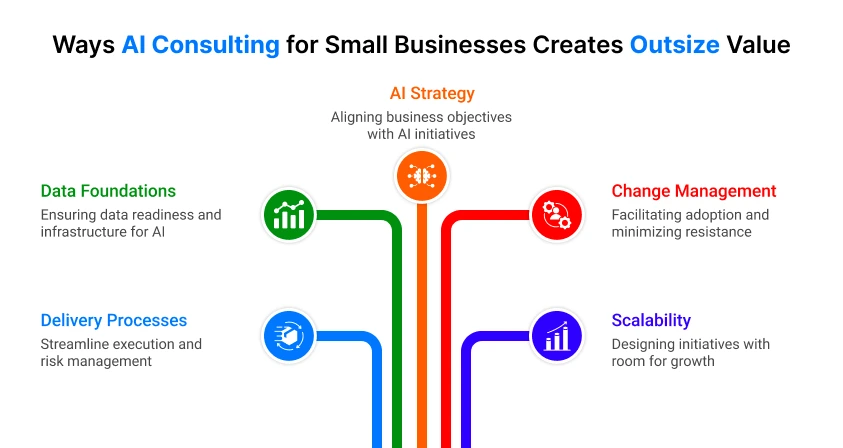
In practice, sustained value emerges from consulting-led alignment between business objectives, data foundations, and delivery processes. Across engagements, outcomes consistently fall into five areas.
8.1. AI Strategy
Effective consulting begins with translating business objectives into clearly scoped use cases. This stage defines what problems are addressed, how outcomes are measured, and which initiatives are sequenced first. Rather than selecting tools upfront, strategy work establishes boundaries around feasibility, data availability, and operational impact. This ensures effort is allocated to initiatives that can be implemented and maintained within existing constraints.
8.2. AI Technology Infrastructure and Data Strategy
Technical implementation depends on data conditions. Consultants assess data sources, quality controls, lineage, access policies, and system integration readiness. Gaps are addressed through architecture design, pipeline definition, and governance frameworks. AI development services at this stage also include advising on platform selection and build-versus-buy decisions so scalability does not introduce unnecessary cost or operational dependency.
8.3. AI Implementation and Risk Management
Deployment extends beyond model delivery. AI consulting services define monitoring practices, access controls, and compliance alignment so systems operate reliably in production. Risk management focuses on data security, auditability, and performance tracking, reducing exposure as usage expands. This approach enables repeatable deployment rather than one-off delivery.
8.4. AI Change Management
Adoption depends on operational ownership. Consultants support role definition, workflow updates, and targeted training so teams can operate and extend systems independently. In engagements led by NetSet Software Solutions, enablement is treated as a delivery requirement, not a post-implementation activity, ensuring continuity after initial rollout.
8.5. Right-Sized AI Initiatives with Room to Scale
Initiatives are structured as contained deployments with defined success metrics. Early results inform refinement and expansion, allowing scale only when data, systems, and processes are ready. This approach controls risk while building a factual case for further investment.
Together, these focus areas explain why consulting-led implementation delivers disproportionate returns for small businesses. Alignment across strategy, data, execution, and ownership converts limited resources into sustained operational improvement without adding unnecessary complexity.
9. Data Readiness and Infrastructure for AI Success
Data readiness determines whether AI systems operate reliably in production or remain confined to experimentation. Infrastructure decisions made early directly affect accuracy, scalability, security, and long-term maintainability. A technical approach focuses on verifiable data conditions and repeatable system design rather than tooling preferences.
9.1. Data quality standards
AI systems depend on consistent, well-defined data inputs. Quality standards establish how data is created, validated, and maintained across sources. Key requirements typically include:
- clearly defined schemas and data contracts
- validation rules for completeness, accuracy, and timeliness
- versioning controls to manage structural change
- documented ownership for each dataset
Without enforced standards, downstream systems inherit inconsistencies that degrade performance and complicate troubleshooting.
9.2. Integration and pipelines
Reliable pipelines convert raw data into usable signals. Integration design focuses on how data moves between systems, how failures are handled, and how changes are applied across downstream systems. Effective pipelines include:
- automated data extractions from operational systems
- transformation logic with audit trails
- failure recovery with predefined execution limits
- monitoring for latency, volume, and schema drift
Well-designed pipelines reduce manual intervention and ensure that models operate on current, traceable inputs.
9.3. Storage and governance
Storage architecture determines how data can be accessed, secured, and retained. Choices between warehouses, lakes, or hybrid models should reflect access patterns and compliance requirements. Governance frameworks define how data is controlled through:
- role-based access and permission boundaries
- retention and policy-driven data removal rules
- encryption and key management
- logging for usage and change tracking
Governance is not an overlay; it is embedded into infrastructure design so controls scale with usage.
Together, quality standards, pipelines, and governance form the operational backbone for AI systems. When these elements are designed explicitly, teams can deploy, monitor, and extend solutions with predictable operational behavior. This foundation supports consistent performance, predictable scaling, and controlled risk as AI use expands across business functions.
10. WHERE TO START: Step-by-Step Implementation
Implementation succeeds when work follows a controlled sequence. Each phase must produce clear outputs that determine whether the next step should begin. Skipping phases or merging them prematurely creates dependencies that surface later as delays, rework, or control gaps. A stepwise approach keeps delivery predictable and reviewable.
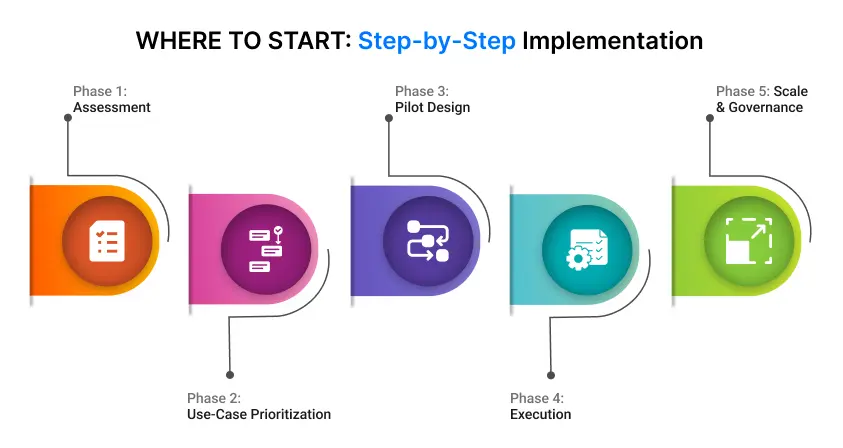
10.1. Phase 1: Assessment
Assessment establishes the baseline for delivery. The objective is to document current conditions across data, systems, processes, and ownership before any solution design begins. This phase focuses on constraints and dependencies rather than future capability.
Activities include reviewing existing workflows, identifying available data sources, mapping system interfaces, and clarifying decision ownership. Findings are documented so later choices are based on verified inputs.
Typical outputs include:
- defined business objectives and decision requirements
- an inventory of data sources and known data limitations
- system boundaries and integration dependencies
- ownership for approvals, changes, and outcomes
This phase determines readiness and identifies prerequisites that must be addressed before moving forward.
10.2. Phase 2: Use-Case Prioritization
Use-case prioritization translates objectives into an executable scope. Candidate initiatives are evaluated comparatively, not independently, to determine which can be delivered first with available resources.
Evaluation criteria usually include expected impact, data availability, delivery complexity, and process alignment. The outcome is a short, ranked list rather than an exhaustive catalog.
Key outputs include:
- a prioritized set of use cases with justification
- success criteria tied to operational measures
- defined scope boundaries and exclusions
- sequencing based on dependencies
This phase concentrates effort and prevents parallel initiatives from competing for the same inputs.
10.3. Phase 3: Pilot Design
Pilot design converts selected use cases into bounded delivery plans. The scope is intentionally limited to test assumptions under controlled conditions. The pilot is designed to operate within existing processes while producing measurable results.
Design outputs typically define:
- required inputs and expected outputs
- workflow changes and user interaction points
- evaluation checkpoints and acceptance conditions
- handling rules for errors and edge cases
A structured pilot validates feasibility without committing the organization to full-scale deployment.
10.4. Phase 4: Execution
Execution moves designs into operation. Work includes data preparation, system configuration, development, testing, and controlled rollout. Progress is tracked against predefined success criteria rather than activity completion alone. Execution management emphasizes traceability and control:
- progress tracking against scope and measures
- documented decisions and changes
- issue resolution through defined authority paths
- preparation for operational handover
This phase confirms that the solution performs as intended in real operating conditions.
10.5. Phase 5: Scale and Governance
Scaling begins only when pilot results meet agreed thresholds. Expansion increases coverage and formalizes controls. Governance structures are introduced to manage changes, reviews, and accountability as usage grows. Typical scale outputs include:
- approval rules for expansion and modification
- review schedules and performance checks
- access boundaries and responsibility assignment
- documentation standards for ongoing operation
This sequence is commonly applied in delivery models used by AI consulting services and AI Development Services providers. At NetSet Software Solutions, this structure is used to ensure each phase produces verifiable outputs before progression.
Following this sequence enables controlled delivery. Each phase builds on validated results from the previous step, allowing organizations to proceed with clarity, reviewability, and operational readiness rather than assumption or momentum.
Execution breaks down when phases are skipped or ownership is unclear. NetSet Software Solutions applies a structured delivery model where each phase, from assessment to scaling, is tied to defined outputs, approval checkpoints, and measurable success criteria. This ensures that AI initiatives move forward only when prerequisites are met, reducing rework, delays, and uncontrolled costs during implementation.
11. Common AI Implementation Risks
AI initiatives often fail not because of intent, but because risks are identified too late. Understanding these risks early allows organizations to reduce exposure, control costs, and protect operational stability. The following risks appear consistently across implementations and should be addressed before scale.
11.1. Data challenges
Data quality remains the most common obstacle. Inconsistent formats, missing records, outdated values, and unclear ownership reduce reliability and limit usefulness. According to Zipdo, 42% of organizations identify data quality as a major barrier to AI implementation. When data inputs are unstable, outputs become unreliable, increasing rework and decision errors.
11.2. Integration complexity
AI systems rarely operate alone. They depend on existing applications, reporting tools, and operational systems. Integration issues arise when interfaces are undocumented, dependencies are unclear, or changes in one system affect others unexpectedly. These issues increase delivery time and create fragile connections that are difficult to maintain.
11.3. Misaligned KPIs
Many initiatives are measured using indicators that do not reflect actual business outcomes. Tracking activity instead of results creates false signals of progress. When KPIs are not aligned with operational goals, teams optimize for metrics that do not improve performance, leading to stalled adoption and unclear value.
11.4. Technical debt
Short-term implementation choices can accumulate long-term costs. Quick fixes, undocumented changes, and temporary workarounds increase maintenance effort over time. As systems evolve, this debt slows updates, increases failure risk, and limits future expansion.
Effective risk management treats these challenges as design inputs, not afterthoughts. Addressing data conditions, integration paths, measurement alignment, and long-term maintainability early reduces disruption and improves execution reliability.
Organizations that acknowledge these risks early are better positioned to plan realistically, allocate effort deliberately, and make informed trade-offs. Risk awareness supports clearer decisions, steadier delivery, and outcomes that remain usable as business conditions, data sources, and systems change evolve.
12. Cost of AI Implementation and Consulting
Understanding how much AI implementation and consulting actually cost is essential for proper budgeting and decision-making. These prices reflect the work required, the maturity of your data and systems, and the outcomes you expect. Recent industry data show consistent ranges across different types of engagements, from smaller-scoped projects to large enterprise programs.
12.1 . Typical Cost Ranges
Industry benchmarks report that a standard AI consulting engagement costs around $450,000 on average. For large enterprise projects, totals commonly exceed $2 million because of complexity and scale.
Here is how costs generally break down by organizational scale:
- Small and mid-sized organizations may invest around $180,000 for a focused project covering strategy, design, and launch of a defined capability.
- Mid-market initiatives usually range from $300,000 to $750,000, where work includes multiple use cases, integration, and change planning.
- Large enterprise efforts often exceed $1 million, with many complete programs going past $2 million due to wider adoption, security and compliance work, and governance frameworks.
These figures provide a realistic starting point for leadership teams preparing formal budgets.
12.2. How Consulting Fees Are Structured
Pricing for AI consulting engagements typically comes from a combination of models based on deliverables and effort:
12.2.1. Fixed Project Fees
These are set prices for well-defined work. Typical phases include:
- Preliminary assessment and strategy development.
- Solution design, development, and testing.
- Deployment and integration into existing systems.
Fixed pricing gives clarity on what is included and makes it easier to obtain internal approvals.
12.2.2.Monthly Retainers
Some organizations prefer ongoing partnerships where a consultant or team is available for continuous support. Monthly retainers often range from modest advisory support to full-time strategic execution arrangements.
12.2.3. Value or Outcome Aligned Pricing
More clients and consulting firms are adopting arrangements where part of the fee relates to measurable business impact. This aligns financial incentives with the results delivered.
Several key elements determine where a project will land in these ranges:
- Scope and clarity: Well-scoped, focused use cases cost less than broad transformational programs.
- Integration complexity: Connecting AI solutions into legacy systems can require engineering work that significantly increases cost.
- Data readiness: Projects with well-structured, clean data require less effort than those needing extensive data engineering.
- Governance and compliance: Industries with strict controls add time and specialist work, which adds to the budget.
Cost increases naturally when more time is spent in discovery, alignment, build, and testing phases.
12.3. Practical Budget Approaches
Effective financial planning treats consulting costs as part of value creation, not just expense. Approaches that work well include:
- Phase-based funding: Allocate the budget in stages such as discovery, pilot, and scale phases.
- Clear deliverables: Define what success looks like at each stage and tie payments to completion of these outcomes.
- Contingency planning: Set aside 10 to 15 percent of the total budget for unexpected work related to data or integration.
This ensures financial discipline and reduces risks of budget overruns while maintaining progress toward measurable results.
13. Return on Investment (ROI)
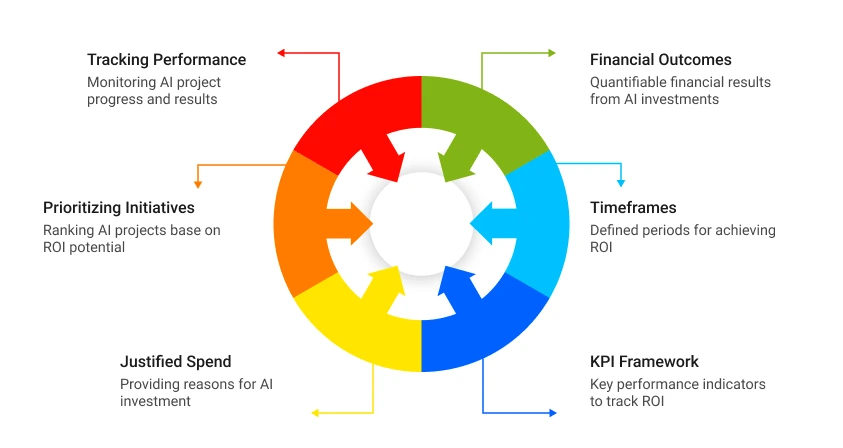
Return on investment is the primary metric executives use to evaluate whether AI consulting delivers measurable business value. Unlike traditional IT initiatives, AI investments are expected to generate quantifiable financial outcomes within defined timeframes. A KPI anchored ROI framework helps organizations justify spend, prioritize initiatives, and track performance after deployment.
13.1. How ROI Is Calculated
At its core, AI ROI follows a standard financial formula:
ROI = (Net Financial Benefit ÷ Total Investment Cost) × 100
Net financial benefit is calculated by aggregating all measurable gains generated by the AI initiative and subtracting total implementation and consulting costs. These gains typically fall into three categories:
- Cost reduction through automation, error reduction, and productivity improvements
- Revenue uplift from better pricing, personalization, demand forecasting, or faster time to market
- Risk mitigation through improved compliance, fraud detection, or operational resilience
To maintain financial accuracy, organizations should calculate ROI over a fixed evaluation period, commonly 12 months, and exclude speculative or non-attributable benefits.
13.2. Benchmark ROI Figures
Industry benchmarks indicate that AI consulting delivers strong financial returns when initiatives are well-scoped and operationally integrated. According to aggregated industry data published by Zipdo, organizations report an average ROI of approximately 245 percent within the first 12 months of AI consulting engagement.
This figure reflects projects where AI solutions moved beyond experimentation into daily operations. Lower returns are typically associated with pilot-only initiatives, while higher returns are observed in automation-heavy and revenue-facing use cases.
13.3. What Drives Higher ROI
Several factors consistently influence ROI outcomes:
- Clear business ownership rather than technology-led experimentation
- Focused use cases tied directly to revenue, cost, or risk metrics
- High data readiness, reducing time spent on rework and data cleanup
- Operational adoption, where AI outputs are embedded into workflows rather than viewed in isolation
Organizations that treat AI as a standalone tool often struggle to realize financial returns, even when technical performance is strong.
13.4. Practical ROI Examples
In operational environments, ROI commonly materializes through measurable improvements such as:
- A customer service operation reducing handling costs by automating high-volume inquiries.
- A supply chain team is lowering inventory holding costs through improved demand forecasting.
- A finance function that reduces revenue leakage by detecting anomalies and compliance gaps.
In these cases, ROI is tracked monthly against baseline performance and adjusted as adoption increases.
13.5. Setting Realistic ROI Expectations
Effective ROI planning starts before development begins. Best practice includes:
- Defining baseline metrics before implementation
- Setting conservative benefit assumptions for early phases
- Tracking results continuously rather than annually
- Reinvesting gains into optimization and expansion
AI consulting delivers its strongest returns when success is measured financially, not technically.
13.6. Key ROI Takeaways
In operational environments, ROI commonly materializes through measurable improvements such as:
- The average reported ROI is approximately 245 percent within 12 months.
- ROI improves when AI initiatives are tightly aligned with business metrics
- Financial performance should be tracked regularly against predefined business metrics.
- ROI clarity builds stake and accelerates adoption
A well-structured ROI framework ensures AI investments are evaluated with the same standardized financial tracking as any other strategic business initiative.
AI investments fail when ROI is not defined or tracked at the business level. NetSet Software Solutions structures every engagement around financial outcomes, including cost reduction, revenue impact, and risk mitigation. By establishing baseline metrics before implementation and tracking performance continuously, businesses gain clear visibility into how AI contributes to profitability within the first 6 to 12 months.
14. AI Implementation Timeline
An AI implementation timeline is determined by execution readiness, not ambition. Organizations often underestimate the effort required to move from concept to stable production use. When engaging AI consulting services, setting realistic timelines early helps align internal teams, budgets, and delivery expectations.
14.1. Typical Project Durations by Phase
14.1.1. Assessment and scoping (4 to 8 weeks)
This phase establishes clarity on the business objective, evaluates data availability, and confirms feasibility. Early decisions made here shape delivery speed later. Delays at this stage are commonly caused by unclear ownership, fragmented data sources, or undefined success metrics.
14.1.2. Design and development (8 to 16 weeks)
This stage covers model design, data pipelines, and application logic. Timelines vary based on the level of customization and integration required. Projects involving custom AI development take longer due to data engineering, testing cycles, and alignment with existing systems.
14.1.3. Testing and validation (4 to 8 weeks)
Testing ensures accuracy, reliability, and operational fit. This includes performance benchmarking, user acceptance testing, and security checks. Compressing this phase increases post deployment risk and remediation cost.
14.1.4. Deployment and integration (4 to 6 weeks)
Deployment focuses on production readiness, system integration, and controlled rollout. Integration complexity is the most common cause of schedule extension during this phase.
14.1.5. Optimization and scaling (ongoing)
After launch, tuning, adoption monitoring, and incremental expansion begin. For organizations relying on AI solutions for business, this phase determines long-term performance and sustainability.
14.1.6. Expectations and Operational Reality
Most AI initiatives reach stable production use within 4 to 9 months. Shorter timelines are achievable only when data quality, governance, and decision-making processes are already mature.
14.1.7. Post-deployment optimization (ongoing)
After launch, tuning, adoption tracking, and incremental expansion begin. This phase determines long-term value and is frequently underestimated.
14.2. Expectations and Operational Reality
In practice, most AI implementation efforts reach stable production use within 4 to 9 months. Expectations of faster delivery often overlook data preparation, integration work, and internal coordination. Organizations that succeed treat AI development services as phased operational programs, not single delivery events.
14.3. Operational Takeaways
- Data readiness has the greatest impact on delivery speed
- Clear accountability reduces timeline slippage
- Stabilization after launch is essential for sustained performance
This timeline framework reflects how AI programs operate in real production environments.
15. AI Tools, Platforms, and Technologies
AI implementations rely on a layered technology stack rather than a single tool or platform. Understanding how these components work together helps organizations make informed architectural decisions and avoid fragmented or redundant systems. A well-designed stack balances flexibility, scalability, and operational control.
15.1. Core Tech Stack Categories
15.1.1. Data and Infrastructure Layer
This layer provides storage, compute, and data pipelines. Cloud platforms such as Amazon Web Services, Microsoft Azure, and Google Cloud enable scalable compute, managed databases, and secure data access. The primary benefit is elasticity, allowing AI workloads to scale without heavy upfront infrastructure investment.
15.1.2. Model Development and Frameworks
Frameworks like TensorFlow and PyTorch are used to build, train, and evaluate machine learning models. These tools support customization and transparency, which are critical when models must be tuned to specific business requirements.
15.1.3. Foundation Models and APIs
Large language models and pretrained APIs accelerate development by reducing the need for training from scratch. Platforms such as OpenAI and Anthropic provide access to advanced language and reasoning capabilities. The benefit here is speed, enabling teams to focus on integration and business logic rather than core model training.
15.1.4. MLOps and Deployment Tools
Tools like MLflow and Kubeflow support versioning, monitoring, and controlled deployment. These platforms help maintain reliability and traceability once models are in production.
15.1.5. Application and Integration Layer
This layer connects AI outputs to business systems such as CRM, ERP, or internal dashboards. APIs, workflow engines, and middleware ensure AI insights are embedded directly into day-to-day operations.
15.1.6. Technology Selection Considerations
No single platform fits every use case. Effective stacks are chosen based on data sensitivity, integration complexity, performance requirements, and internal technical capabilities. A modular approach allows organizations to evolve their AI capabilities without reengineering the entire stack.
A clear understanding of these technologies enables teams to build AI systems that are scalable, maintainable, and aligned with real operational needs.
16. Post-Implementation Support and Scaling
Deployment is only the point where AI systems begin operating under real business conditions. Long-term performance depends on how well these systems are governed, monitored, and extended after go-live.
16.1. Operational Control Through Governance
Once an AI system is live, governance defines how it is allowed to evolve. This includes assigning ownership, documenting decision logic, and establishing approval mechanisms for updates. As data and usage patterns change, periodic reviews ensure models continue to meet accuracy, fairness, and regulatory standards. Effective governance reduces the risk of unmanaged changes, particularly when AI outputs influence revenue, customer interactions, or compliance decisions.
16.2. Production Monitoring and MLOps
MLOps provides the operational foundation required to keep AI systems stable in production. Monitoring focuses on accuracy trends, data drift, latency, and overall system reliability. Early indicators allow teams to address issues before they affect business outcomes. Version control, testing pipelines, and controlled rollouts ensure that updates are traceable and reversible, supporting confidence in day-to-day operations.
16.3. Scaling Without Compromising Stability
Scaling AI is most effective when it builds on proven results. Expansion should follow standardized deployment patterns, reuse validated components, and align with clear business priorities. This approach enables growth across teams or regions without introducing unnecessary operational risk or fragmentation.
16.4. Sustained Support Model
NetSet Software Solutions approach to post-implementation as a continuous engagement. The emphasis is on improving performance over time, strengthening governance practices, and maintaining architectures that support controlled expansion.
17. Challenges Businesses Face Before Hiring AI Consulting Services
Before engaging an external consulting partner, most organizations attempt internal evaluation or pilot development. This stage typically exposes structural gaps that increase implementation cost, delay timelines, and reduce the probability of achieving measurable outcomes.
17.1. Undefined Business Use Cases
AI initiatives often begin without clearly defined problem statements or success criteria. Projects are initiated based on tool availability rather than operational requirements.
Observed impact:
- Development effort allocated to low-impact use cases
- Absence of measurable KPIs tied to revenue, cost, or risk
- Inability to justify continued investment
In practical terms, 20–30% of initial budget allocation is consumed in exploratory work without production outcomes.
17.2. Data Readiness and Quality Constraints
AI systems require structured, validated, and consistent datasets. In most organizations, data exists but lacks standardization, lineage tracking, and quality controls.
Common issues:
- Inconsistent schemas across systems
- Missing or outdated records
- No defined ownership or validation processes
These conditions introduce additional engineering effort. Projects with unresolved data constraints typically experience 25–50% cost escalation due to data preparation and rework.
17.3. Limited Internal Capability Across the AI Lifecycle
AI implementation requires coordination across data engineering, model development, deployment, and monitoring. Internal teams are often optimized for application development, not full lifecycle AI systems.
Execution gaps include:
- Incorrect architectural decisions
- Delayed deployment cycles
- Lack of monitoring and model maintenance capability
This results in extended timelines and increased cost of iteration. Structured AI consulting services address this by aligning technical execution with operational requirements.
17.4. Integration Complexity with Existing Systems
AI solutions must operate within existing enterprise environments, including CRM, ERP, and workflow systems. Integration dependencies are often underestimated during initial planning.
Typical constraints:
- Undocumented system interfaces
- Dependency conflicts across applications
- Lack of standardized APIs
Integration challenges introduce variability in delivery timelines and cost. In most cases, 15–25% of the total project cost is attributable to integration-related effort.
17.5. Absence of a Defined ROI Framework
Investment decisions require a clear financial model. Many organizations initiate AI projects without baseline metrics or defined evaluation periods.
Common gaps:
- No pre-implementation performance benchmarks
- Benefits not mapped to financial outcomes
- No post-deployment tracking mechanisms
This results in unclear value realization and limits the ability to scale successful initiatives.
17.6. Cost Overruns Due to Unstructured Execution
Without defined delivery phases, governance controls, and approval checkpoints, AI initiatives expand in scope over time.
Observed outcomes:
- Budget overruns due to scope creep
- Rework caused by early-stage design gaps
- Systems that do not transition to production
Unstructured implementations frequently exceed planned budgets by 30–60%, primarily due to re-engineering and lack of execution control.
Execution Implication: These constraints are not isolated technical issues. They directly increase the total cost of ownership, delay time to production, and reduce return on investment. Addressing them requires structured planning, defined execution models, and financial accountability.
18. Business Impact of AI Consulting with NetSet Software Solutions (Cost-Aligned Execution)
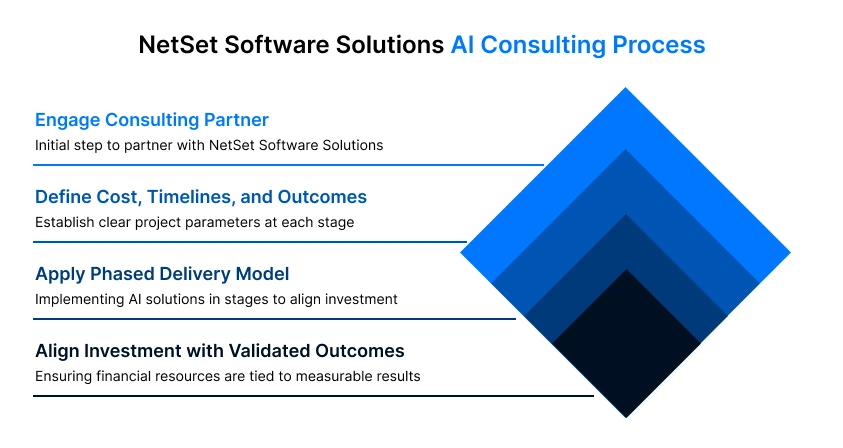
Engaging a consulting partner introduces a controlled execution model where cost, timelines, and outcomes are defined at each stage. The primary impact is financial predictability and measurable return rather than exploratory development.
NetSet Software Solutions applies a phased delivery model that aligns investment with validated outcomes.
18.1. Cost Control Through Phased Delivery
Implementation is divided into assessment, pilot, and scale phases. Each phase includes defined deliverables, acceptance criteria, and approval checkpoints.
This approach:
- Eliminates unnecessary development effort
- Prevents scope expansion without validation
- Aligns resource allocation with confirmed outcomes
Organizations typically achieve a 20–35% reduction in avoidable project cost compared to unstructured execution.
18.2. Reduced Time-to-Production Lowers Total Cost
Project duration directly affects cost through resource utilization and operational overhead.
With structured execution:
- Feasible use cases are validated early
- Development focuses on production readiness
- Deployment occurs within 4–9 months for most implementations
Shorter delivery cycles reduce cumulative cost and accelerate return realization.
18.3. ROI-Driven Implementation Model
Each initiative is mapped to quantifiable financial outcomes before development begins. These include cost reduction, revenue improvement, or risk mitigation.
Execution includes:
- Baseline metric definition
- Continuous performance tracking
- Outcome-based evaluation over defined periods
Industry benchmarks indicate 200–250% ROI within 12 months for implementations aligned with operational workflows.
18.4. Reduction in Long-Term Cost of Ownership
Systems are designed with scalability, monitoring, and governance controls from the initial phase.
This reduces:
- Technical debt accumulation
- Maintenance overhead
- Cost of system redesign
Over a multi-year period, organizations can reduce the total cost of ownership by 30–40% through structured implementation.
18.5. Predictable Investment Ranges
Consulting-led engagements define cost based on scope, integration complexity, and data readiness.
Typical investment ranges:
- Focused implementations: $150,000 – $250,000
- Multi-use-case deployments: $300,000 – $750,000
- Enterprise-scale programs: $1M+
The distinguishing factor is not cost magnitude but cost predictability and alignment with measurable outcomes.
18.6. Cost-to-Outcome Alignment in Practice
AI investment is evaluated based on financial return relative to implementation cost.
Examples of measurable impact:
- Automation is reducing recurring operational expenses
- Forecasting improves revenue planning accuracy by 5–10%
- Process optimization, reducing manual effort and cycle time
This is where custom AI development and AI solutions for business deliver value, as systems are designed around defined operational and financial objectives.
19. The Future of AI Impact on SMEs
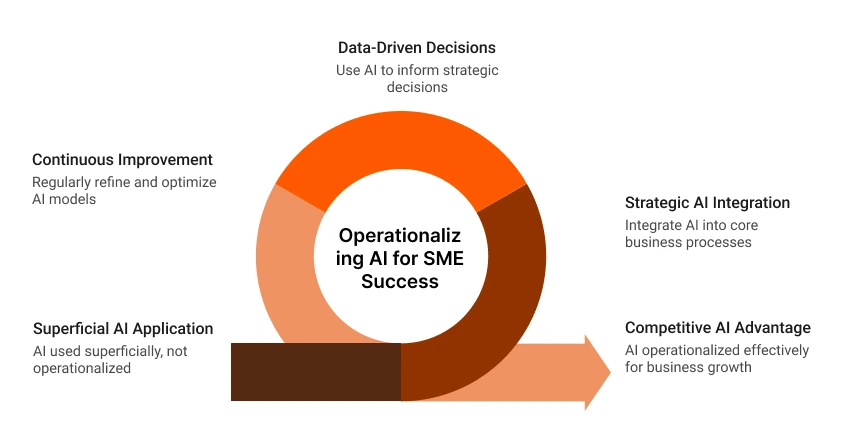
For small and mid-sized enterprises, AI is no longer a future. It is quickly becoming a baseline capability. Over the next phase of adoption, the competitive gap will widen not between companies that use AI and those that do not, but between those that operationalize it well and those that apply it superficially.
19.1. What Changes First
The earliest impact will appear in execution speed. SMEs will use AI to shorten decision cycles, reduce manual oversight, and standardize judgment across functions such as sales forecasting, customer support, and financial operations. This shift favors businesses that prioritize repeatable systems over ad hoc decision-making.
19.2. How the Workforce Evolves
AI adoption will rebalance responsibilities rather than reduce headcount. Teams will spend less time validating data and more time acting on it. Roles will tilt toward oversight, exception handling, and strategy. SMEs that fail to redefine responsibilities risk underutilizing both their tools and their people.
19.3. A New Competitive Reality
AI removes many of the scale advantages traditionally held by larger firms. Smaller organizations can now operate with comparable insight, responsiveness, and cost discipline. At the same time, expectations rise across the market. Faster response times, personalized experiences, and data-backed decisions become assumed, not differentiated.
The future of AI for SMEs is not about experimentation. It is about staying viable in markets where operational intelligence becomes the default.
20. How NetSet.AI Helps Businesses Successfully Implement AI?
AI succeeds in business only when it is executed with structure, governance, and financial accountability. NetSet.AI, backed by the delivery capabilities of NetSet Software Solutions, applies a proven implementation model designed to move AI from concept to controlled production.
Over-automation is usually the first mistake. When workflows are automated before they’re fully understood, human judgment disappears too soon.
20.1. Structured Delivery Methodology
Every engagement starts with a business and data assessment to confirm feasibility, economic value, and risk exposure. This step establishes clear success metrics and prevents misaligned use cases.
Implementation follows a phased roadmap focused on priority use cases with defined ownership and release checkpoints. Deployment is integrated into existing systems, not layered on top of them. Governance frameworks are applied early, covering model accountability, auditability, and controlled updates.
20.2. Proven Operational Impact
This approach has enabled clients to reduce operational friction, improve forecast reliability, and standardize decision-making across teams. Independent industry research consistently shows higher returns from AI programs that apply phased delivery and governance-led execution rather than tool-first adoption.
20.3. Why NetSet.AI?
NetSet.AI operates without platform bias and measures success in operational and financial terms. Post-deployment monitoring and optimization ensure systems remain stable as data and business conditions change.
The result is AI that performs reliably in production and scales with business demand.
21. Conclusion
AI adoption is no longer optional. It is a strategic capability that directly influences efficiency, decision quality, and long-term competitiveness. Across assessment, implementation, governance, and scaling, the same success factors apply: clear business objectives, disciplined execution, and accountability for measurable outcomes. Organizations that treat AI as operational infrastructure, rather than isolated experimentation, are consistently better positioned to realize sustained value.
Execution ultimately determines results. NetSet Software Solutions supports organizations through this full lifecycle, combining structured delivery, governance-led implementation, and production-grade engineering. This approach enables AI systems that operate reliably, scale responsibly, and remain aligned with business goals over time.
For organizations ready to move beyond pilots and achieve durable outcomes, the opportunity is not simply to adopt AI, but to operationalize it with clarity, control, and confidence.
Frequently Asked Questions (FAQs)
1. What are the top AI consulting services available for small businesses?
AI consulting services for small businesses include AI strategy, data readiness assessment, use-case validation, workflow automation, AI implementation, and performance monitoring focused on measurable ROI.
2. How does AI consulting for small businesses work?
AI consulting works by aligning business goals with the right AI use cases, assessing data readiness, deploying AI solutions, and tracking results to ensure business impact.
3. How can Generative AI consulting services boost my business?
Generative AI consulting improves efficiency by automating content creation, customer support, reporting, and internal workflows, allowing businesses to scale output without increasing costs.
4. Who are the top providers of AI implementation services?
Leading AI implementation providers combine strategy, engineering, and governance expertise. Companies like NetSet Software Solutions deliver end-to-end AI implementation focused on scalability and ROI.
5. How do you sell AI consulting services effectively?
AI consulting services are sold by clearly linking AI solutions to business outcomes such as cost reduction, efficiency improvement, or revenue growth, an approach used by firms like NetSet Software Solutions.